Sign up for the Free Tangle Newsletter Highly curated unbiased news for busy, open-minded people.
Processing your application
Please check your inbox and click the link to confirm your subscription.
There was an error sending the email
A counter-protester with a U.S. flag in front of Immigration and Customs Enforcement (ICE) agents, outside the Whipple Federal Building in Minneapolis, Minnesota | REUTERS/Tim Evans

By Erin C. M. Anderson


Less than two weeks ago, 2,000 federal agents were deployed to my city. Only a week has passed, as of this writing, since a woman was killed by an ICE agent shortly after dropping her child off at school — and only a handful of days more since the federal government announced an additional 1,000 agents would be deployed here.

Mainstream media is covering our story, mostly in broad strokes. They have other stories they need to tell.

But our story — the story of Minneapolis, St. Paul, the metro area — is the only one I hear. It surrounds me. It surrounds my neighbors. It surrounds us.

It is grief. It is anger. It is disbelief. And in some cases, ambivalence. Since this is a city, enclaves will remain insulated to some degree — but less so with each new day.

Three days ago, I watched a group of four ICE vehicles swarm a car driven by a very young man.

He was in a middle-class residential neighborhood. He didn't try to run, and ICE didn’t chase him down — ICE just suddenly swarmed him at an intersection, forcing his car to slant awkwardly across the intersection as he tried to pull to the side. I watched masked agents pull him from his car; they displayed no warrant and asked no questions.

His skin was brown, and he was so very young, surrounded by armed men who dragged him from his vehicle without a chance to respond.

Neighbors came out of their homes. Passersby stopped. People bore witness. People called out, asking his name and whom to notify.

I never learned his name. I may never know it. If I were to see him again, I don’t know that I would recognize him. Because all I can recall clearly a few days later is strobing lights, weapons, and uncertainty.
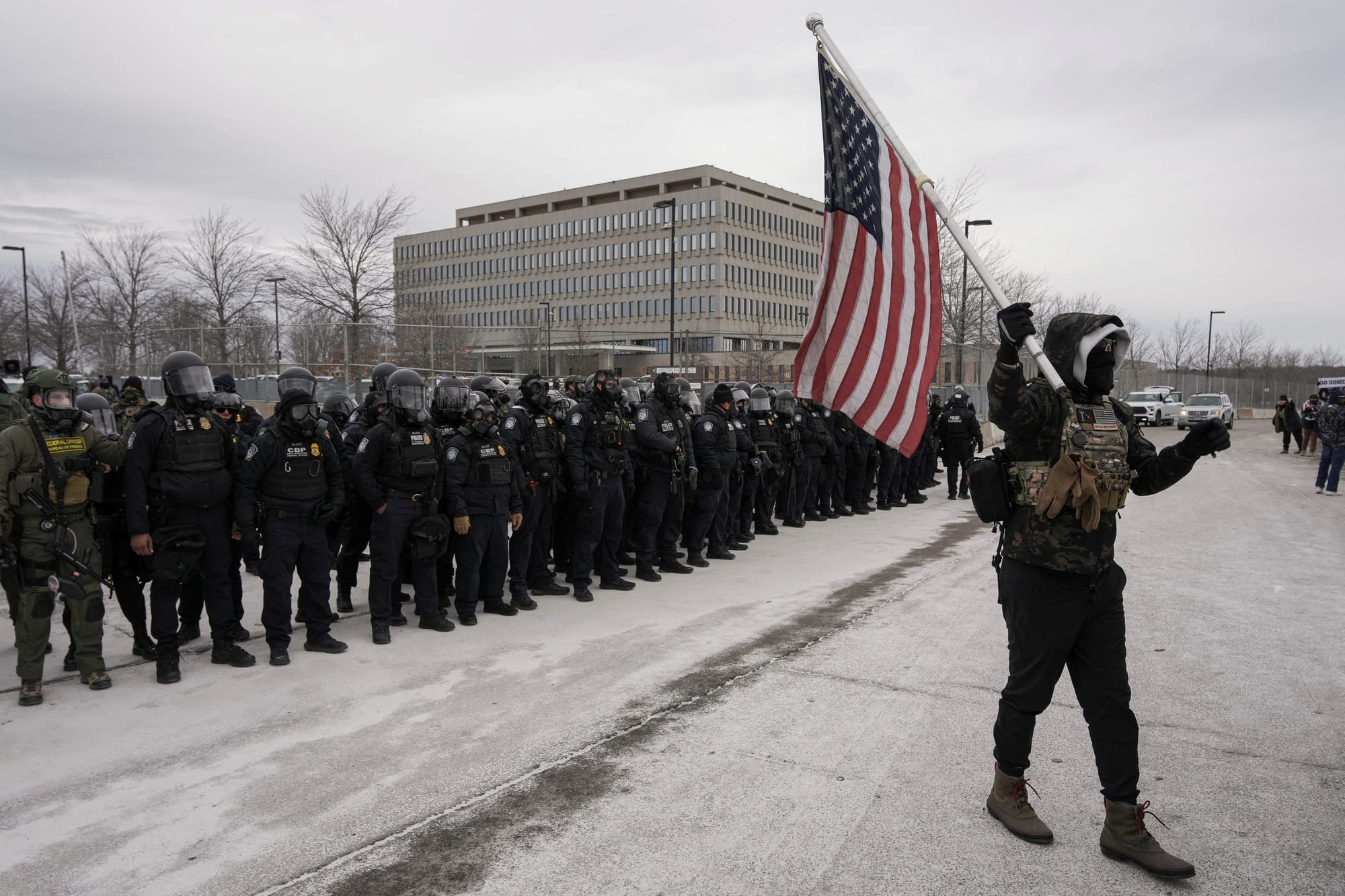

It is not a sight I or others here can un-see, or one we can discount or make smaller because there is no distance left between us and what we are witnessing. We are all starting to see it.

But if you’re not here, you can’t possibly see — or feel — the violence and the pain.

Before that young man, I had seen small convoys of agents speeding through town. I had witnessed a home with agents clustered in the doorway, trying to gain access. I had been to multiple locked grocery stores where you knocked to be let in, but only after staff checked the parking lot to make sure it was safe to open the door.

Since then, I have seen cars with windows broken out and left in the road, more forced stops, and green gas glowing under streetlights bathing entire residential blocks in an acrid burning while neighbors shout at agents to leave our city alone.

From a distance, to dismiss all of this as necessary steps to catch illegal aliens and criminals would be easy. We have federal immigration laws, and we expect laws to be enforced.

But the news cannot convey the breadth of what is occurring or the impact it has on one’s sense of identity and safety.

Before Operation Metro Surge began, I could not have imagined what coexisting with a mass immigration enforcement would feel like — the well of anger and fear and sorrow that would become my daily companion. There is a tightness in my chest that comes close to suffocating. A deep unease suffuses my body when I see an SUV with tinted windows, as I now reflexively look to see if the license plates are local (relief) or out-of-state, mismatched, or simply missing. Anxiety distorts my vision into something tunnel-like while driving when helicopters circle overhead.

I don't know how to live with seeing groups of SUVs with neither lights nor sirens driving recklessly through our streets, running lights, driving the wrong way down one-way streets, and treating our already under-enforced traffic laws with complete disregard; or with seeing groups of armed men dragging terrified people away from their lives; or driving past vehicles left on the side of the road with children still sitting in their car seats, alone. I never expected to guard for the indiscriminate use of tear gas canisters on any roadway, with or without protesters, but I now know to keep my windows up, shut down my air system, and head to the car wash. What I desperately do not want to know is how to live with people I am used to seeing out and about no longer showing up… and not knowing if they are staying home in fear or if they have been swept up and deported, effectively disappeared.

Cleaners aren’t leaving their homes. Carpenters are holed up with their families. Nursing aides are struggling to get into and out of work safely. Students are staying home because their parents are afraid of ICE agents parked across the street from their schools.

In most cases, the people who are being swept up are not committing crimes. They were here holding jobs, buying groceries, paying taxes and rent or mortgages — until they were not.

I've been through workshops on immigration in the past, thanks to educational opportunities for working journalists. Our system is a cobbled-together mess of rules and regulations that carve out different exceptions and pathways based on which groups lawmakers wanted to prioritize at different times in our past. Apolitical bureaucrats working for the federal government have been flagging the need to fix the system for every decade of my nearly 60 years. Fund allocation is rarely decided based on need. Optics frequently outweigh reality in political decision-making. No one is arguing that the immigration system is functional. But what is happening in my city, in the name of fixing immigration issues, is a cruel farce. One that looks like an effort to enforce authoritarianism.

Despair is a radicalizing force. And the inhumanity of how ICE is going about its business, its blatant disregard for due process and civil rights, can only create despair.

We are not a unified people in many regards. We hold different ideas on how to achieve our goals as a community. But in this, the people of the Twin Cities are largely choosing to stand with their neighbors. If we don't, what choice will we have but despair?

For those who would cast the people fighting that radicalizing path of despair as unreasonable, you may not be seeing the forest for the trees.


Erin Anderson is a retired rural journalist from Wisconsin who covered agriculture, education, and natural resources before moving to the Twin Cities. Now she gardens and paints.

Member comments

More from Tangle News related to this article

Recently Popular on Tangle News