
By Christian Gray, Yinka Onayemi, and Frank Obermeyer
At the beginning of law school, my co-author, Yinka, and I both enrolled in Georgetown Law’s alternative first-year curriculum known as Section 3. The purpose of Section 3 is to teach traditionally distinct legal courses together in order to demonstrate the shared philosophical underpinnings of the law (or something like that). So, while traditional curriculums involve one semester of contracts and another in torts, we spent our full first year in the combined “Bargain, Exchange, and Liability,” blurring the lines between contractual and civic duties and waxing poetic on the potential socio-political motivations underlying the evolution of law.
We will admit, Section 3 occasionally felt needlessly academic for both Yinka’s (from Chicago, Illinois) and my (from Dayton, Ohio) pragmatic, midwestern, meat-and-potatoes sensibilities. And yet, despite its sporadic intellectual indulgences, we continue to find ourselves altogether grateful for the way in which Section 3 challenged us to not only learn the law but also to step outside of its structure, interrogate its origins, and measure its effects on the merits. And so when Yinka and I — later joined to our great benefit by a childhood friend, Frank Obermeyer — began considering how America might solve the problem of gerrymandering, we approached the issue in the only way we knew how: instead of asking how we might make districting more “fair,” we asked ourselves why we maintain geographic districts in the first place.
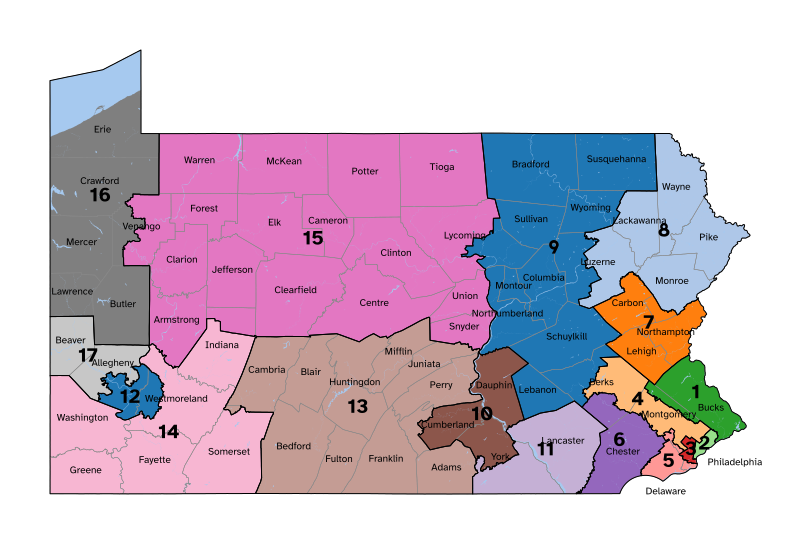
The ultimate problem of gerrymandering begins and ends with the way we divide the electoral constituencies of the U.S. House into geographic districts. By prioritizing geography over other potential divisions, we empower the ruling party in each state to draw geographic districts in ways that dilute the voting power of minority-party voters. Given that, in 2019, the Supreme Court declared claims regarding partisan gerrymandering political questions beyond the reach of the federal judiciary, perhaps the only surprise is that state officials took until now to push gerrymandering to the brink.
But gerrymandering is not inevitable because the Constitution does not actually require that states divide their electoral constituencies into geographically-divided districts; it only requires, to the extent districts are drawn, that states draw such districts with roughly equal populations. By forgoing geographic districts entirely and restructuring the electoral constituencies of the House into less manipulable voting blocs, we can deprive state legislators of the power to disenfranchise minority-party voters in red and blue states alike. After consideration, we feel the best replacement for geographic districts would be state-wide, age-based voting blocs.
Here’s how this would work:
Just as now, each state would receive a number of representatives based on its population — but everything after that would change. States would divide their voters into state-wide, age-based voting blocs of equal number, and each of which would elect a representative to Congress. Representatives need not themselves come from the age group they represent; we would leave it to voters to determine who best represents their interests.
This approach has several advantages over geographic districts.
First, states cannot gerrymander basic math. Because the Constitution would require that age-based voting blocs, like geographic districts, be composed of a roughly equal number of voters, the division of voters into their respective blocs would become an administrative task of simple division, guided by demographics — not politics. Let’s take an example: if Ohio has a fifteen-member delegation and nine million voters, the youngest 600,000 Ohioans would comprise one voting bloc, the next youngest 600,000 would comprise the next, and so-on-and-so-forth in increments of 600,000 up the chain.
Second, age-based voting blocs closely align with Constitutional principles. Though the Equal Protection Clause compels states to draw districts of as close to equal population as possible, states have some flexibility in making such divisions based on the practical complications of drawing districts. The mathematical simplicity of age-based voting blocs, however, would practically ensure adherence to this clause by allowing only minimal deviations between the population of each bloc. Moreover, age-based voting blocs would eliminate any possibility of plainly unconstitutional racial gerrymandering, thus relieving courts of the burden of distinguishing constitutional partisan gerrymanders from unconstitutional racial ones.
Third, age-based voting blocs will re-invigorate American checks and balances. We have watched as Congress has fallen into a dangerous tendency to act in one of two ways: When the majority of House members share the same party as the president, the House rubber-stamps the president’s wishes, betraying its role as a check. But when the majority of House members originate from the president’s opposition party, the majority stonewalls the president’s prerogatives, betraying its duty for balance.
Given the geographic structure of our House and growing nationalization of our politics, this is no surprise. At one time, electing representatives from small geographic districts promised to fill the House with idiosyncratic political actors whose pursuit of local prerogatives left them more willing to buck their party in exchange for the right benefit to local constituents. But as legislators find their constituencies increasingly motivated by national issues over local ones, the political rewards for pursuing local political interests decreases, and the incentives for district representatives to buck the wishes of national party leaders declines.
But the declining political importance of local issues does not mean that America is devoid of other idiosyncratic political divisions that we might leverage to instill a diversity of salient political interests in Congress. For instance, Professor Daniel Hopkins notes in his book on political nationalization, “The Increasingly United States,” that “we should still expect to see different political attitudes in different places,” but “those attitudinal differences should be chiefly a function of individual-level differences.” By restructuring the House around these more politically salient “individual-level differences,” we can equip legislators with constituencies who will once again reward representatives for pursuing goals that may differ from national party platforms and thereby create a more dynamic legislature that does not simply march to the beat of national party drums. And age is a perfect individual-level difference to divide our Congressional districts — mathematically arbitrary yet politically salient and easily definable.
So how do we do this?
The path to restructuring the House lies with Congress. Today, voting takes place at precincts within geographic Congressional districts — this feels obvious, but the administrative division of voter precincts and the electoral division of constituencies do not actually have to coincide. The Constitution grants both U.S. states and Congress concurrent authority to prescribe “the Times, Places, and Manner of holding elections for . . . Representatives,” but it gives Congress the final say to “make or alter such Regulations,” with surprisingly few affirmative requirements for how the House of Representatives must be constituted or its members elected. Congress could redesign much of what we take for granted about geographic-district-based voting today — and indeed, at times in the past, it already had.
For example, until 1967, states such as New Mexico and Hawaii elected House representatives through at-large elections, meaning voters throughout the entire state voted on all of the state’s representatives. Since 1967, the Uniform Congressional District Act (UCDA) has required states to elect representatives from single-member districts. Without the UCDA, we have not identified any federal law that would prevent states from rejecting geographic districts, so long as alternatives abided by other Constitutional and statutory requirements. So all Congress would need to do to open a path for age-based voting blocs is repeal UCDA.
We caution, however, that if Congress repeals the UCDA, it must replace it. Without a federal replacement, states may re-enshrine at-large voting — effectively an even more severe gerrymander that would result in the election of entire state House delegations on simple majorities, even if extremely narrow ones.
There is one other logistical elephant in the room: Even if a U.S. legislator supports the democratic principles underlying an age-based Congress, why should they support a Congressional shuffle that promises only to increase the competition for their own seats? They probably will not.
We therefore propose that Congress structure any bill enacting age-based voting blocs such that it only becomes effective in any given state once all sitting representatives of that state, at the time of passage, have either been defeated or retired from Congress. By delaying the effectuation of reform, legislators could pursue democratic ideals without risk to their personal political power.
We believe now is the time for this change.
Americans of all political stripes share an increasing dissatisfaction with Congress, with recent approval ratings as low as fifteen percent. This dissatisfaction threatens to erode our institutions entirely, as political actors from all sides leverage growing cynicism to stomp on political guardrails that have long protected our nation from some of the worst political excesses. By restructuring the constituencies of the House, we can do away with gerrymandering as a critical source of cynicism, re-enfranchise millions, re-incentivize proper checks and balances, and re-invigorate our democracy.
Not only is it a workable reform, but we believe it is the duty of Congress to enact it. The founders did not assign to Congress the solemn power to oversee House elections in order for Congress to play the role of a potted plant in a wilting democracy. As red and blue states alike recklessly abandon democratic principles in a short-sighted game of political brinkmanship, Congress must intervene — and soon.
Christian Gray is an attorney specializing in privacy and data security law in Chicago, Illinois. He earned his law degree from Georgetown Law and his B.A. in Political Science from the Ohio State University.
Yinka Onayemi is an attorney specializing in complex commercial disputes in New York City. He earned his law degree from Georgetown Law, his Masters in Law from L'Institut d'études politiques de Paris, and his B.A. in Economics from Colby College.
Frank Obermeyer is a law clerk pending admission to the New York bar. He earned his law degree from Harvard Law School and his B.S. from St. John’s University.
This opinion piece is meant to reflect the personal views of the authors only. It does not reflect the views of any other persons or entities in any way associated with any of the authors.

Member comments