
I’m Isaac Saul, and this is Tangle: an independent, nonpartisan, subscriber-supported politics newsletter that summarizes the best arguments from across the political spectrum on the news of the day — then “my take.”
Are you new here? Get free emails to your inbox daily. Would you rather listen? You can find our podcast here.
Today’s read: 12 minutes.
Experts identify major culprit behind aging
It’s well known that as we age, we can expect less energy, more tiredness, and weaker muscles, but did you know the root of this issue lies at the cellular level?
Starting in our 30s, the mitochondria, responsible for 90% of your body’s energy, take on damage with time and our cells slowly lose the ability to repair it, wearing down our physical strength and endurance.
Meet Mitopure®, a clinically proven breakthrough over 15 years in the making that replaces aging mitochondria and increases cellular energy. The results? Studies found participants saw muscle strength and endurance increase without any changes to exercise.
Special offer: Tangle readers get 30% off for a limited time.
*This is sponsored content.
A reminder.
As part of our mission to make news accessible, we keep 80–90% of our content free. However, memberships keep the lights on — and they also unlock Friday editions, ad-free newsletters, ad-free podcasts, exclusive interviews, original reporting, and personal essays. We have over 60,000 Tangle members, and every month 99% of them choose to keep their membership because it’s just that worth it. If you want to unlock some more great content and support the kind of independent, nonpartisan work we do, please consider becoming a member. It’s less than $5/month (the cost of a beer) when you subscribe for the year.
Quick hits.
- Law enforcement arrested a suspect in the killing of Minnesota state House Leader Melissa Hortman (D) and her husband and the attempted killing of state Sen. John Hoffman (D) and his wife. The suspect is charged with two counts each of second-degree murder and second-degree attempted murder. (The arrest)
- Israel and Iran traded attacks for the fourth consecutive day, with Israel claiming to have killed Islamic Revolutionary Guard Corps intelligence chief Mohammad Kazemi, and Iran striking an Israeli oil refinery and several locations in and around Tel Aviv. Israel says Iran’s strikes killed 24 people, and Iran says Israel’s killed 224 people. (The latest) Separately, President Donald Trump reportedly rejected an Israeli plan to assassinate Iran's Supreme Leader Ayatollah Ali Khamenei. (The plan)
- President Trump reportedly instructed Immigration and Customs Enforcement officials to pause immigration raids and arrests in the agricultural, hospitality, and restaurant industries, which Trump recently acknowledged had been negatively impacted by his immigration crackdown. (The report)
- President Trump signed legislation blocking California from banning the sale of new gas-powered cars by 2035. The measures revoke the Environmental Protection Agency waivers that enable the EV rule. (The block)
- Flash flooding in San Antonio killed at least 13 people over the weekend. (The flooding)
Today’s topic.
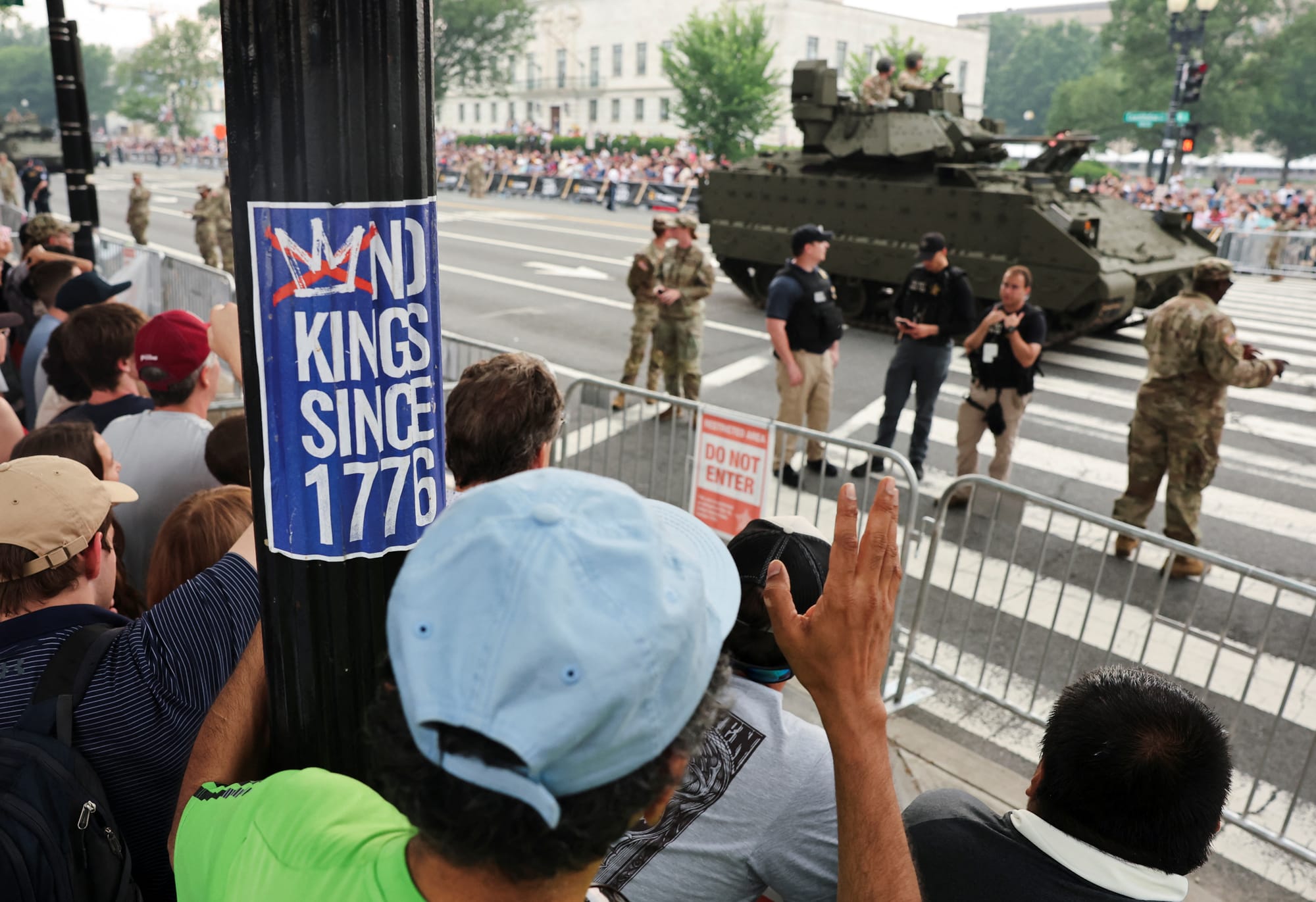
The military parade and “No Kings” protests. On Saturday, the U.S. Army held a festival and parade in Washington, D.C., to commemorate its 250th anniversary, an event spearheaded by President Donald Trump. The same day, protesters gathered in over 2,000 cities across 50 states to demonstrate against the Trump administration.
The parade was held to commemorate the 250th anniversary of the Second Continental Congress voting to create the Continental Army after the first battles of the Revolutionary War at Lexington and Concord. In his first term, President Trump had pushed for a parade to celebrate the U.S. armed forces, but planning was halted due to cost and logistical challenges. The Army had been planning festivities to mark the occasion prior to the start of Trump’s second term, but did not begin parade preparations until April. The event also coincided with President Trump’s 79th birthday.
Approximately 6,700 soldiers participated in the parade, which also featured roughly 84 military vehicles and 50 aircraft. President Trump framed the event as a celebration of America’s military achievements, remarking, “Every other country celebrates their victories. It’s about time America did, too. That’s what we’re doing tonight.”
Also on Saturday, anti-Trump “No Kings” protests were held across the country. Organizers said the protests were “the largest single-day mobilization since President Trump returned to office,” calling them a rejection of “authoritarianism, billionaire-first politics, and the militarization of our democracy.” Organizers from Indivisible estimated that millions of people participated, and a litany of progressive organizations — including the ACLU, Common Cause, and the Service Employees International Union — helped plan and support the demonstrations.
“No Kings is really about standing up for democracy, standing up for people’s rights and liberties in this country and against the gross abuse of power that we’ve seen consistently from the Trump administration,” the ACLU’s Chief Political and Advocacy Officer Deirdre Schifeling said.
The protests were largely peaceful, with only a few reports of confrontations with police. However, at a protest in Salt Lake City, a bystander was killed when security officials shot at an armed man in the crowd. Additionally, police said a man intentionally drove an SUV through protests in Culpeper, Virginia; the driver has been arrested and no injuries have been reported, though at least one person was struck by the car. Lastly, authorities in Texas briefly shut down a planned demonstration at the state capitol following reports of a credible threat against lawmakers planning to attend. The protest eventually went ahead, and one arrest was made in connection to the threats.
Today, we’ll share views from the right and left on the military parade and No Kings protests across the U.S. Then, my take.
What the right is saying.
- The right criticizes the message and organizing themes behind the No Kings protests.
- Some suggest the value offered by the military parade was not worth the cost.
- Others say the left continues to protest ineffectively against Trump.
In The Daily Caller, Adam Johnston said the “‘No Kings’ protestors are wrong about Flag Day.”
“When the left speaks of defending ‘our sacred democracy,’ what they really mean is defending their hold on institutional power while utilizing regime-aligned direct action events like ‘No Kings’ to intimidate their legitimate political opposition,” Johnston wrote. “Despite the left’s fear-mongering and rhetoric about Trump acting as a king, his presidency has been marked not by unchecked power, but by the subversion and nullification of his legitimate executive power under Article II of the U.S. Constitution while fighting constant resistance from within the very institutions he was elected to lead.”
“When the left cries ‘No Kings!’ as Trump attempts to exercise his authority to remove criminal illegal aliens from the country, it is not fighting against despotism; it is fighting against the reassertion of National sovereignty,” Johnston said. “Ultimately, judging by the Mexican flag-waving rioters in Los Angeles, ‘No Kings’ means no borders and eventually, no country. Trump is not a king — he is a duly elected president attempting to dismantle a hostile regime that treats democracy as a slogan and subversion as a sacrament.”
In Reason, Billy Binion criticized the military parade as a “waste.”
“Beauty is in the eye of the beholder. The parade will, however, objectively be big, from the contents of the parade itself—25 M1 Abrams main battle tanks! Dozens of other military vehicles! Aircrafts! 6,600 soldiers marching!—to the price tag, which is currently estimated to come out somewhere between $25 million and $45 million for an approximately 90-minute event. That comes out to $277,778–$500,000 per minute,” Binion wrote. “A majority of Americans, it turns out, do not think that big cost is beautiful; 60 percent of respondents in a recent poll said the parade is not a good use of taxpayer money.”
“The millions of dollars the public is paying to fund the parade — which will take place on Saturday, Trump's 79th birthday — are ‘peanuts,’ the president said, when ‘compared to the value.’ Yet it is difficult to reconcile that position with one of his hallmark campaign promises: reining in wasteful government spending,” Binion said. “Indeed, during the 2024 campaign, Trump promised to slash $2 trillion — the size of the budget deficit — in federal spending. That was always a bit hard to believe, particularly when considering the immense amount he added to the national debt during his first term, trillions of dollars of which came before the COVID-19 pandemic.”
In The Wall Street Journal, Kimberley A. Strassel wrote about “diminishing protest returns.”
“Political memories are short, but none more fleeting than that of the Democratic collective. We’ve been doing this for nearly a decade, and always to the left’s detriment,” Strassel said. “A brief walk down protest lane: In the opening months of Mr. Trump’s first presidency, the ‘resistance’ staged the Women’s March, airport protests against his travel ban, demonstrations against pipeline projects, a Day Without Latinos, a Day Without Immigrants, Not My President’s Day, Resist Trump Tuesday, protests for transgender rights, a Day Without a Woman, a Tax March (April 15), a March for Science and May Day protests. Aside from a few images of ladies in funny pink hats howling at the sky, do you remember any of it?”
“The protesters’ history, message and tactics are, in any event, obscuring any moral claim. Ten years into Mr. Trump’s political career, this looks and feels like any other protest of Mr. Trump — i.e., like a partisan moment,” Strassel wrote. “The bigger problem for Democrats? For too many weary Americans, it continues to feel as if protest is all the left’s got. The foot-stomping is unaccompanied by serious plans for immigration reform, or an outreach to Republicans on a way forward, or a discussion, or regret for the mistakes that led to their loss last November. It’s all outrage.”
What the left is saying.
- The left mostly criticizes the military parade as a partisan exercise with ominous undertones.
- Some say the No Kings protests were a success and demonstrated the popular opposition to Trump.
- Others argue Trump is politicizing the military as a tool to consolidate power.
In Vox, Zack Beauchamp called the military parade “a warning.”
“Donald Trump’s military parade in Washington this weekend — a show of force in the capital that just happens to take place on the president’s birthday — smacks of authoritarian Dear Leader-style politics,” Beauchamp wrote. “The totality of Trump administration policies, ranging from the parade in Washington to the LA troop deployment to Secretary of Defense Pete Hegseth’s firing of high-ranking women and officers of color, suggests a concerted effort to erode the military’s professional ethos and turn it into an institution subservient to the Trump administration’s whims.”
“For all its faults, the US military’s professional ethos is a really important part of its identity and self-conception. While few soldiers may actually read Sam Huntington or similar scholars, the general idea that they serve the people and the republic is a bedrock principle among the ranks. There is a reason why the United States has never, in over 250 years of governance, experienced a military coup,” Beauchamp said. But “we don’t really know how the US military will respond to a situation like this. Like so many of Trump’s second-term policies, their efforts to bend the military to their will are unprecedented — actions with no real parallel in the modern history of the American military.”
In The Philadelphia Inquirer, Will Bunch wrote “at ‘No Kings,’ millions of Americans show the flag is mightier than the tank.”
“The 47th president had hoped to rule over Flag Day by deploying the artillery of a strutting strongman, in his long-awaited D.C. parade that rolled 28 Abrams M1A2 tanks and Stryker armored personnel carriers into the capital, as Blackhawk helicopters and fighter jets buzzed the wet and muggy skies,” Bunch said. “But Trump had already been defeated in the streets, by everyday citizens who stopped his immoral invasion against the soul of America with a thin red, white and blue wall. On an unforgettable day when several million regular folks marched for an event called ‘No Kings,’ the American flag was mightier than the tank.”
“The overriding message from ‘No Kings’ was one of courage. The organizers were never looking for unrest but simply for big numbers, to show not just other Americans but an increasingly anxious world that Trump and ICE are not acting in their name. The longer-term hope is that massive resistance from the people will change not only the warped media narrative after Trump’s 2024 election, but also convince enough lawmakers on Capitol Hill to block his extreme agenda,” Bunch wrote. “Saturday’s vibe shift was clearly felt in Washington, where the tank-driven parade that so many feared would provide a chilling glimpse of North Korea-spiced totalitarianism on the Potomac turned out to be a surprisingly low-energy affair.”
In The Atlantic, Graham Parsons said the parade was “another step in an ongoing effort to turn the U.S. military into a partisan — and personal — instrument of the president.”
“A mark of a free society is that its public institutions, especially its military, represent the body politic and the freedom-enabling equal rights that structure civic life. If service members and the public begin to believe that the military is not neutral but is in fact the servant of MAGA, this will threaten the military’s legitimacy and increase the likelihood of violent conflict between the military and the public,” Parsons wrote. “The organizers have made it abundantly clear that [the parade’s] purpose is to directly laud Trump and his politics. In promotional materials, they tell us, ‘Under President Trump’s leadership, the Army has been restored to strength and readiness.’ They credit his ‘America First agenda’ for military pay increases, enlarged weapons stockpiles, new technologies, and improvements in recruitment.”
“The president now routinely speaks to uniformed service members in his red MAGA hat, using his trademark rhetoric centering himself and belittling, even demonizing, his critics. He openly suggests a special alliance between him and the military. At Fort Bragg on Tuesday, for instance, Trump encouraged uniformed soldiers to cheer his political agenda and boo his enemies,” Parsons said. “This is all extremely dangerous. Keeping the military a politically neutral servant of the constitutional order, not of the president or his political ideology, is vital to ensuring the security of civil society.”
My take.
Reminder: “My take” is a section where I give myself space to share my own personal opinion. If you have feedback, criticism or compliments, don't unsubscribe. Write in by replying to this email, or leave a comment.
- Despite my apprehensions, this weekend’s protests were incredibly peaceful — and effective.
- Meanwhile, the military parade was a pretty non-noteworthy affair, but had its genuinely cool moments.
- As a whole, the weekend gave me a very optimistic feeling about our country.
If you had asked my feelings about the protests and parade on Friday, before either of them had played out, my reaction would have been pretty pessimistic. The parade seemed like a glorified birthday party that I felt was fundamentally un-American. At the same timeI was concerned that the protests could break out into violence, and I was particularly worried that the protests would clash with the parade in some meaningful, dangerous way.
I didn’t make any of these predictions publicly, so I could pretend I never had these thoughts; but I did have them. And I was wrong on all counts.
The “No Kings” protests managed to be both widespread and entirely peaceful. I leveled some harsh criticism towards the bad eggs demonstrating in Los Angeles, so it’s only fair to call out how remarkably without incident all these protests were. Tens of thousands of people hit the streets in Philly alone, and I even heard of protests organized in the tiny West Texas town where I have a home — despite it being incredibly small, remote, and politically diverse. I saw zero reports of protesters causing significant property damage or violently instigating the police, despite millions of people participating across the country. A couple protests in Los Angeles and Portland got a little heated later in the day, but they seemed to be more of an extension of ongoing anti-ICE demonstrations and unrelated to the mass No Kings effort.
Given how big the protests were, this is a really incredible achievement worth celebrating.
As for the parade, it ended up just… not generating that much interest. It was a kind of sleepy affair that seemed to be poorly organized. It had some genuinely embarrassing moments (like soldiers carrying drones), but also some genuinely cool moments that showed off the incredible components and history of the U.S. military (like the flyovers around the Washington Monument). Trump did not make the parade about himself, as many critics anticipated. Instead, the parade focused on celebrating the 250-year history of the Army. All the people handwringing about how it would end up as a kind of dictatorship on display also vastly overplayed their hands — a lot of people showed up, soaked in the interesting procession of U.S. history, marveled at the tanks in the streets, gazed at the military aircraft overhead, and then they went home.
Does the event mark another step our country’s making to becoming more like Russia or North Korea? Does it show Trump evolving into Putin? I think, obviously, it doesn’t. It really was just a parade. The event seemed kind of interesting and very uneventful. Aside from it being a conspicuous example of wasteful government spending at a time when the administration says it’s focused on saving money, I found it wholly inoffensive.
In terms of their broader implications, the No Kings protests seemed far more significant to me. The Democratic “resistance” to Trump has been pretty uninspired over the first few months of Trump’s second term, but this weekend was a total shift in energy. It reminded me of the Women’s March in 2017 that set the tone for protest activity and a string of electoral victories throughout Trump’s term. “No Kings” is also an example of strong, simple, attractive messaging that Democrats have desperately lacked — and I think it’s a message that will resonate with a lot of independent and moderate voters who fear Trump’s penchant for power grabs. It certainly is an appealing message to me; I don’t want any kings here.
And, on the note of comparisons to modern despotisms in North Korea and Russia, five million-plus people in 2,100 towns just hit the streets to protest Trump without any limitations to their free speech. None of them were arrested or disappeared. None of them were thrown into a gulag. There was no organized attempt to limit their constitutional rights in any meaningful or noticeable way — they all went out in public and chanted critical things about their president, often escorted and protected by local or state police, while holding up some offensive signs and saying pretty much whatever they wanted. To all the people worried about us slipping into authoritarianism, that simple fact should serve as a clear reminder that we are a long way from becoming Hungary or Russia; we live in a great big free country where you’re allowed to say publicly that you hate your president and not get meaningfully punished for it. And that’s a blessing.
I found all of this — the peaceful organization and appealing message of the protests, the uneventful and moderately interesting parade, the celebration of our armed forces without any clashes with protesters — quite heartening, and altogether a beautiful, holistic picture of patriotism. On the exact same weekend, both sides of America’s tribal politics got to hit the streets to celebrate our military or protest the president, and they did so without major issues. These moments that provide genuine political optimism can be so easily overshadowed, so we should celebrate when our messy, pluralistic society produces some perfectly acceptable political expression.
Take the survey: What do you think of the parade and the protests? Let us know!
Disagree? That's okay. My opinion is just one of many. Write in and let us know why, and we'll consider publishing your feedback.
Help share Tangle.
I'm a firm believer that our politics would be a little bit better if everyone were reading balanced news that allows room for debate, disagreement, and multiple perspectives. If you can take 15 seconds to share Tangle with a few friends I'd really appreciate it — just click the button below and pick some people to email it to!
- Email Tangle to a friend by clicking here.
- Share Tangle on X/Twitter by clicking here.
- Share Tangle on Facebook by clicking here.
Your questions, answered.
Q: What recourse does the Judicial Branch have if the president refuses to obey the court's ruling? Wouldn't Congress need to start impeachment proceedings? What are the odds of this Congress (which has been sitting on its hands thus far) actually doing anything?
— Daniel from Chicago, IL
Tangle: A few months ago, when Isaac was on paternity leave, our Managing Editor Ari Weitzman sat down with Ray Brescia, a professor at Albany Law School, and asked him some questions about the legality of the Department of Government Efficiency and the executive branch not spending federal budget as allocated by Congress. Brescia told us how a court order or Congressional dictate is enforced if someone in the executive branch defies it.
“Congress can impeach and remove them if there are the votes,” Brescia said. “But individual agency heads can be impeached and removed if they don't follow the law, as well.”
So, yes, impeachment is a normal tool to use if Congress believes that the president, or any member of the executive branch, is defying the law. However, that scenario is probably not likely under the current Congress, which has a Republican majority in both chambers. And since a two-thirds majority is needed for a conviction in an impeachment proceeding, a congressional proceeding generating legal ramifications is even more unlikely.
Impeachment is not the only potential recourse, though. Federal judges can find an agent of the executive branch in contempt of court, bringing criminal charges to a specific person. Judges can convict government agents of criminal contempt — which would carry jail time but have to be enforced by the U.S. Attorney and could be pardoned — or civil contempt — which would impose fines and is not pardonable. Enforcing charges against federal agents would involve the U.S. Marshals, potentially creating an inter-governmental power struggle that could trigger a constitutional crisis.
This would be a pretty significant step, but it also isn’t something we think is too likely to happen. As we’ve mentioned before, the Trump Administration has eventually complied with every court order it has received.
Want to have a question answered in the newsletter? You can reply to this email (it goes straight to our inbox) or fill out this form.
Under the radar.
On Tuesday, June 17, the Senate is set to vote on the GENIUS Act, a bill that would create a legal framework for regulating “stablecoins,” a type of cryptocurrency designed to maintain a relatively stable value. The legislation would require these coins to be fully backed by U.S. dollars or similarly liquid assets, establish annual audits for issuers with more than $50 billion in market capitalization, and add compliance guidelines for foreign issuers. The House of Representatives is advancing its own stablecoin legislation separately, and the two bills differ in how they would regulate stablecoins at the state and federal levels. If passed, the Senate bill would need House approval before it heads to President Trump’s desk. The Block has the story.
Keep strong muscles as you age.
Maintaining muscle strength is key to healthy aging, but over time, our muscle integrity naturally decreases. Mitopure® is a powerful healthy aging solution shown in clinical studies to significantly increase muscle strength and energy. Even better? Studies show participants saw significant increases without any change in exercise. Tangle readers can start their journey to stronger muscles today with 30% off.
Numbers.
- 1991. Prior to Saturday, the year of the last U.S. military parade, which celebrated the end of the Gulf War.
- $40 million. The estimated cost of Saturday’s parade in Washington, D.C.
- 45 million. The weight, in tons, of the military equipment used in Saturday’s parade.
- 64%. The percentage of U.S. adults who said they oppose the use of government funds for the military parade in Washington, D.C., according to a May–June NBC News/SurveyMonkey poll.
- 88% and 72%. The percentage of Democrats and independents, respectively, who oppose the use of government funds for the military parade.
- 65%. The percentage of Republicans who support the use of government funds for the military parade.
- 5 million. The approximate number of “No Kings” protesters in the United States on Saturday, according to organizers.
- 200,000, 100,000, and 70,000. The estimated number of protesters in Los Angeles, Philadelphia and Seattle, respectively.
The extras.
- One year ago today we had just published a random assortment of staff favorites.
- The most clicked link in Thursday’s newsletter was Robert F. Kennedy Jr. announcing eight new members of the vaccine panel, days after dismissing all of its members.
- Nothing to do with politics: An Instagram channel makes AI videos of celebrities teaching math, like Joe Rogan explaining a Fourier Series.
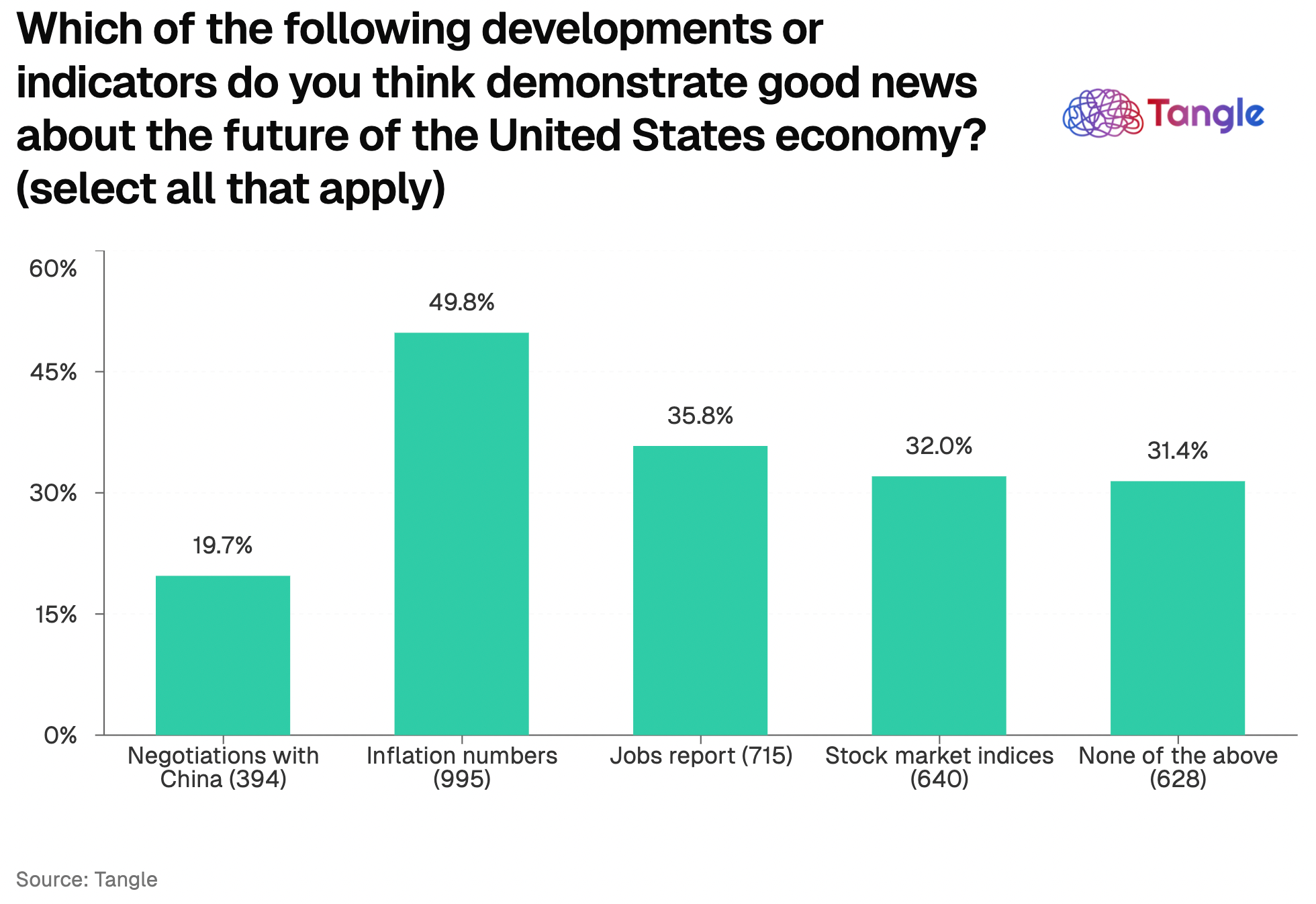
- Thursday’s survey: 1,997 readers answered our survey on the latest economic metrics with 50% saying the inflation report presents good news. “Focus on trade balances, and focus on buying American!,” one respondent said.
Have a nice day.
A survey by Road Scholar, a nonprofit that provides education and travel services to seniors, found 94% of those aged 50 to 98 reported higher levels of happiness if they “aged adventurously.” The respondents defined the term as staying physically active, traveling, and continuing to learn as they age — some even said they feel just as happy as they did in their 20s and 30s. Good Good Good has the story.
Don’t forget...
🎥 Follow us on Instagram here or subscribe to our YouTube channel here
🎉 Want to reach 390,000+ people? Fill out this form to advertise with us.

Member comments