
I'm Isaac Saul, and this is Tangle: an independent, nonpartisan, subscriber-supported politics newsletter that summarizes the best arguments from across the political spectrum on the news of the day — then “my take.”
Are you new here? Get free emails to your inbox daily. Would you rather listen? You can find our podcast here.
Today’s read: 16 minutes.
We’re doing a deep dive.
One of the most frequently asked questions from readers over the last few weeks has been about the Department of Homeland Security’s (DHS) hiring and training practices. We’re putting together a story to better understand exactly what that process looks like, and the experience for agents on the ground. If you or anyone you know works for DHS, or its enforcement arms of Immigration and Customs Enforcement (ICE) and Customs and Border Patrol (CBP), we’d love to talk with you and learn more. Just drop us a line on Signal by searching our username @tanglenews.96 or clicking the link here (you’ll have to download the app to message). You can also reach out to testimonials@readtangle.com.
Quick hits.
- According to a government report sent to Congress, two U.S. Customs and Border Protection agents fired their weapons during the shooting of Alex Pretti in Minneapolis on Saturday. The report does not state whether Pretti’s firearm discharged at any point during the encounter. (The update) Separately, House Democrats said they will begin impeachment proceedings against Homeland Security Secretary Kristi Noem if President Donald Trump does not remove her. (The threat)
- Border Patrol agents shot and wounded a man in Arizona. Officials said they were attempting to apprehend the man as a suspect in a human-trafficking investigation when he fled and began firing at agents and a Border Patrol helicopter. (The shooting)
- During a town hall, a man sprayed Rep. Ilhan Omar (D-MN) with an unknown substance. Omar said she was unharmed and continued with the town hall. (The incident)
- The families of two Trinidadian men who were killed in a U.S. strike on a boat allegedly trafficking drugs sued the U.S. government for wrongful death and extrajudicial killing. It is the first such lawsuit filed in federal court related to the Trump administration’s boat strikes. (The suits)
- India and the European Union agreed to a free-trade deal that will eliminate or reduce tariffs on most goods traded between the economies. (The deal)
16 Nearly Secret Things To Do If You Have Amazon Prime
If you shop on Amazon regularly, there’s a good chance you’re leaving real money on the table every single month.
Many shoppers don’t realize there are simple tools, features, and settings built right into Amazon that can help you save more and even earn extra cash on purchases you’re already making.
We’ve put together 16 lesser-known Amazon hacks that can unlock serious savings. These tips can help you lower prices, earn cash back, stop paying for subscriptions you don’t use, and avoid common Amazon charges most people never notice.
And the best part?
You don’t need to buy anything new or change how you shop. There’s no complicated setup or learning curve here. Instead of paying full price and moving on, you can start getting more value out of purchases you’re already making.
Today’s topic.
The measles outbreaks. Last week, South Carolina officials reported that measles is transmitting rapidly in the state, with 789 confirmed cases so far. South Carolina is the fifth state to accumulate at least 100 measles cases since January 2025, joining Utah, New Mexico, Arizona, and Texas (where the first cases in 2025 were reported). During the current outbreaks, over 150 children have been hospitalized with measles; two children and one adult (all unvaccinated) have died from measles complications, the first such deaths in the U.S. in a decade.
Back up: Measles, or rubeola, is a highly contagious airborne viral infection characterized by a high fever, cough, runny nose, and a blotchy rash. Once a common childhood disease, scientific advancements have mitigated its incidence and severity. Most people who contract measles recover within 10 days, but severe cases can be deadly for those with weakened immune systems, including children under five.
In January, measles was reported in a largely unvaccinated Mennonite community in West Texas. The disease spread from there, with 762 cases in Texas reported by August, growing into the largest single outbreak of measles in the United States since 2000 (when the disease was declared eliminated in the country). The Texas outbreak ended in August, but cases continued to be reported in other states. According to the U.S. Centers for Disease Control and Prevention (CDC), a total of 2,255 measles cases were confirmed in the United States in 2025, marking the worst year for measles in over two decades. So far in 2026, the CDC has confirmed 416 cases across 14 jurisdictions.
To maintain its elimination status, the United States must demonstrate that transmissions of the disease were not sustained across outbreaks. The World Health Organization defines elimination as 12 consecutive months without sustained transmission; the U.S. loses its elimination status, it will join Spain, Austria, Armenia, Azerbaijan, Uzbekistan, the United Kingdom, and Canada as nations that have lost their elimination status in the past year.
Leaders at the Department of Health and Human Services have downplayed the current outbreaks. “It’s just the cost of doing business with our borders being somewhat porous for global and international travel,” Ralph Abraham, principal deputy director at the CDC, said. Despite the American Academy of Pediatrics recently breaking from the CDC over its vaccination schedule, both bodies still recommend parents provide their children with the MMR (measles, mumps, and rubella) vaccine.
Recent outbreaks in the U.S. and across the globe have reignited debates over childhood vaccinations. According to CDC data, 93% of confirmed measles cases in 2025 occurred in individuals who did not receive the measles vaccine or whose vaccination status is unknown. Many vaccine skeptics frame the choice to forgo the vaccine as a personal decision, while proponents stress that at least 95% of the population must vaccinate to provide herd immunity to those who are medically unable to vaccinate.
Below, we’ll get into what the right, left, and scientific community is saying about the measles outbreak. Then, Managing Editor Ari Weitzman gives his take.
What the left is saying.
- The left worries that more outbreaks are coming — and top health leaders are not meeting the moment.
- Some argue this outcome is a result of RFK Jr.’s messaging about vaccines.
In The Washington Post, Leana S. Wen called the return of measles “a public health tragedy.”
“Time will tell how many more people will become infected and fall seriously ill in this outbreak. What’s certain is that this outbreak will not be the last. At least 15 states have proposed legislation to loosen vaccine requirements. In Texas, lawmakers have already introduced more than 20 such bills this year,” Wen said. “Robert F. Kennedy Jr., the newly confirmed health and human services secretary, refuses to disavow the debunked theory that MMR is linked to autism. And among the several thousand Department of Health and Human Services employees terminated in Elon Musk’s purge of government agencies are those tasked with disease investigation and outbreak response.
“It’s been said that vaccines are a victim of their own success. Indeed, younger generations fail to appreciate the extraordinary benefit of vaccines because they have never seen the lethal illnesses that vaccines help avert,” Wen wrote. “One can only hope that parents learn this lesson before more children are infected and suffer the consequences of measles and other vaccine-preventable diseases.”
In Scientific American in April 2025, Dan Vergano criticized “the brainwashing campaign that is measles misinformation.”
“Why is this happening? An April poll on measles beliefs from the health policy-centered Kaiser Family Foundation tells us. One quarter of the 1,380 people surveyed believe the false notion that the measles vaccine causes autism. Some 19 percent mistakenly believe the vaccine is more dangerous than the deadly virus it prevents,” Vergano said. “This is a shameful, mass propaganda campaign, unfolding in real time, championed by our top health official… We are on the brink of an epidemic, one that could make millions of people sick with measles each year, and this is all being done for political and personal gain, with children as the collateral damage.”
“In 2024 Trump brought RFK, Jr. (whom he once accused of being a ‘fake’ anti-vaxxer) onto his campaign precisely for his anti-medical establishment credentials. Kennedy’s views, steadily peddled on right-wing outlets, attracted measles-vaccine-doubting voters. It was a classic case of ‘If you can’t beat ’em on lying about vaccines, give him control of the nation’s public health apparatus,’” Vergano wrote. “For the politicians and the grifters who pump out this dangerous dishonesty, these deaths don’t matter, so long as they get the votes. For everyone else, the deadly spread of measles is the dismal future they now promise our kids.”
What the right is saying.
- Many on the right are also concerned about the outbreak and say public health officials are fueling vaccine skepticism.
- Some suggest the severity of the outbreak is being overstated.
The Wall Street Journal editorial board wrote about “measles as a ‘cost of doing business.’”
“Asked by the press this week if he’s worried about this, CDC principal deputy director Ralph Abraham — recently appointed by Health and Human Services Secretary Robert F. Kennedy Jr. — shrugged. ‘Not really,’ he replied. ‘You know, it’s just the cost of doing business, with our borders being somewhat porous [and] global and international travel,’” the board said. “Not really. Fewer than 2% of U.S. cases have been imported from abroad. But outbreaks happen when vaccination rates fall below the levels needed to maintain herd immunity, which is about 95%. The kindergarten vaccination rate in South Carolina was 91% during the 2024-2025 school year.”
“Outbreaks have increased because childhood immunizations have declined since the pandemic… Mr. Kennedy has fueled the vaccine distrust, even saying the vaccine causes disabilities and death like the virus. It doesn’t,” the board wrote. “Like his boss, Dr. Abraham claims people should be ‘free’ not to vaccinate children… The problem with this line is that unvaccinated children can sicken infants and immuno-compromised children who can’t be inoculated, leaving some disabled or worse. In a better Administration, government leaders would explain this to parents rather than brush aside serious illness as inconsequential.”
In Hot Air, David Strom criticized the left’s framing of the measles outbreak.
“If you compare measles rates in the United States with those of our peer countries, including Canada, France, and Germany, we have the lowest per-capita rate, and the number of cases is so low that natural fluctuations of a few cases per year can make the shifts appear large,” Strom said. “Germany and the United States have comparable rates, with extremely few cases in any given year… As for rates of increase? Natural variations account for that, although until a trend can be established, we can’t rule out the possibility that RFK, Jr.’s skepticism might affect future cases. But certainly there is no evidence of that yet.
“How do I know? In 2025, Canada’s per capita rate for measles was 125 per 1,000,000, while the US’s rate was 5.6. In other words, Canada currently has a rate 25 times higher than the United States, suggesting that something other than a few months of vaccine skepticism is at work in the variation,” Strom wrote. “I prefer an actual scientific approach where all the costs and benefits of each jab is examined and weighed, the vaccine schedule as a whole is examined to determine whether there is a better and safer way to give vaccines, and above all, consent only follows complete information provided to parents and other patients.”
What medical experts are saying.
- Some experts say the outbreak will continue to spiral without a better public health approach.
- Others suggest the challenge of containing infectious diseases is rooted in the independence of state health agencies.
In The New York Times in April 2025, Dr. Michael Mina, an epidemiologist and immunologist, wrote “I’m terrified we’re headed for an epidemic.”
“Measles is among the most contagious viruses known… Infants too young for vaccination, immune-compromised people and the elderly are all at risk. Measles isn’t just a fever and rash. It can cause pneumonia, brain inflammation, permanent disability and death,” Mina said. “The current measles outbreak, with more than 480 cases, largely in unvaccinated children, is gearing up to be the worst in years. And it’s likely just the beginning. Recent studies estimate that more than nine million American children are susceptible to measles… 3.6 million infants are too young to be vaccinated and millions of immunocompromised Americans can’t safely receive the vaccine.”
“For infants under 1 who aren’t yet eligible for M.M.R. vaccination and who live in areas where measles is spreading (which is a rapidly expanding list), it’s worth asking your pediatrician about getting the first dose early, as young as 6 months,” Mina wrote. “Instead of focusing on getting people measles vaccines, Mr. Kennedy is putting resources into a study into vaccine-autism links… Public health depends on public trust. When that trust is broken, when people start to see vaccines as personal choices without regard to public health — or, worse, as threats — diseases like measles come roaring back.”
In MedPage Today, Nathaniel Mamo, Dhriti Jagadish, and Arthur Caplan said “science has been lost amidst politics and patchwork state health policy.”
“Also beginning in a small religious community, this year’s measles outbreak emerged in a west Texas Mennonite community with low vaccine coverage. The case rate has surpassed 2019’s and continues to rise, fueled by decreased measles vaccination rates and nationwide spread to nearly every state,” the authors wrote. “While a state may only set public health policies for its residents, the implications extend to the rest of the country. Infectious disease follows people, not borders. Naturally, it should be the federal government’s role to moderate policy differences between jurisdictions. And yet, ours does not. The explanation is not a lack of power but of authority.
“Despite the seemingly mighty stature of federal health agencies, they have little authority over state health departments. States operate health systems largely independent of the federal government, and sometimes directly against,” the authors said. “Increasingly, as the nation’s politics have polarized, public health has become a way of asserting political priorities, giving public health the appearance that it is a matter of ideology and not objectivity. This was on full display during the pandemic, and has come to define American public health today.”
My take.
Reminder: “My take” is a section where we give ourselves space to share a personal opinion. If you have feedback, criticism or compliments, don't unsubscribe. Write in by replying to this email, or leave a comment.
- One of the biggest contributors to vaccine skepticism is an unwillingness to discuss it.
- When you take skeptical points one by one, the argument against the MMR vaccine fails.
- Secretary Kennedy wants to rhapsodize fear; don’t let him.
Managing Editor Ari Weitzman: If you’ve read the above opinions (I hope you did), you’ll find a lot of consensus about the effectiveness of the MMR vaccine to prevent measles. However, you won’t find a lot of engagement with the points made by those who are skeptical or outright opposed to vaccines. So I’d like to jump straight to addressing those concerns.
First, imagine that you have a friend who lost a child under the age of one to an unknown cause. Imagine the pain and confusion that comes with such a tragedy and the desperate desire for answers that follows. That process looks different for everyone, but for a person scouring their own choices for blame, looking into vaccines — often the most obvious medical intervention a child receives after birth — is a natural starting point.
For many people in that situation, page after page of Google searches telling them they’re misguided won’t settle their concerns. Instead, comfort comes from the first believable person who says, “You’re not crazy. Vaccines are dangerous, and I can prove it.”
Today, the most prominent person delivering that message is Robert F. Kennedy Jr. Despite rejecting the label of “anti-vaxxer,” the HHS Secretary has consistently defended the opinion to opt out of the MRR vaccine for years; now, he offers governmental authority for vaccine skeptics to justify their decision.
Instead of dismissing Kennedy’s argument out of hand, I want to address it directly. Using a 2019 article authored by Kennedy in Children’s Health Defense — written before his run for president and still representative of his views today — I’ll respond to his individual points, in his own words, below.
CDC’s mortality and morbidity data suggest that measles fatalities in the pre-vaccine era were 1/500,000 population wide; 1 in 10,000 among infected individuals.
I have found plenty of sources to corroborate this claim. Before vaccines were made available to the public, measles killed 0.2 of every 100,000 people (1/500,000), according to the 1962 paper cited by Kennedy’s source. But Kennedy does some sleight of hand, here, discussing the pre-vaccine mortality rates among infected people and among the general population while omitting the current rates. The median general mortality rate of measles for each year this century is 0 — meaning that, in most years since 2000, nobody in the entire country died of measles. The maximum general mortality rate, set in 2025, is 1:115,000,000 — a mere 320-fold improvement on the pre-vaccine benchmark (at worst).
Among infected people, the mortality rate has been about 1 in 10,000 in the U.S. since 1962 — and roughly 1 out of every 1,000 infected children under 10 (again, according to Kennedy’s own source, Physicians for Informed Consent).
Here’s a chart that Physicians for Informed Consent designed to help you feel comfortable with this number (and nervous about the MMR vaccine):
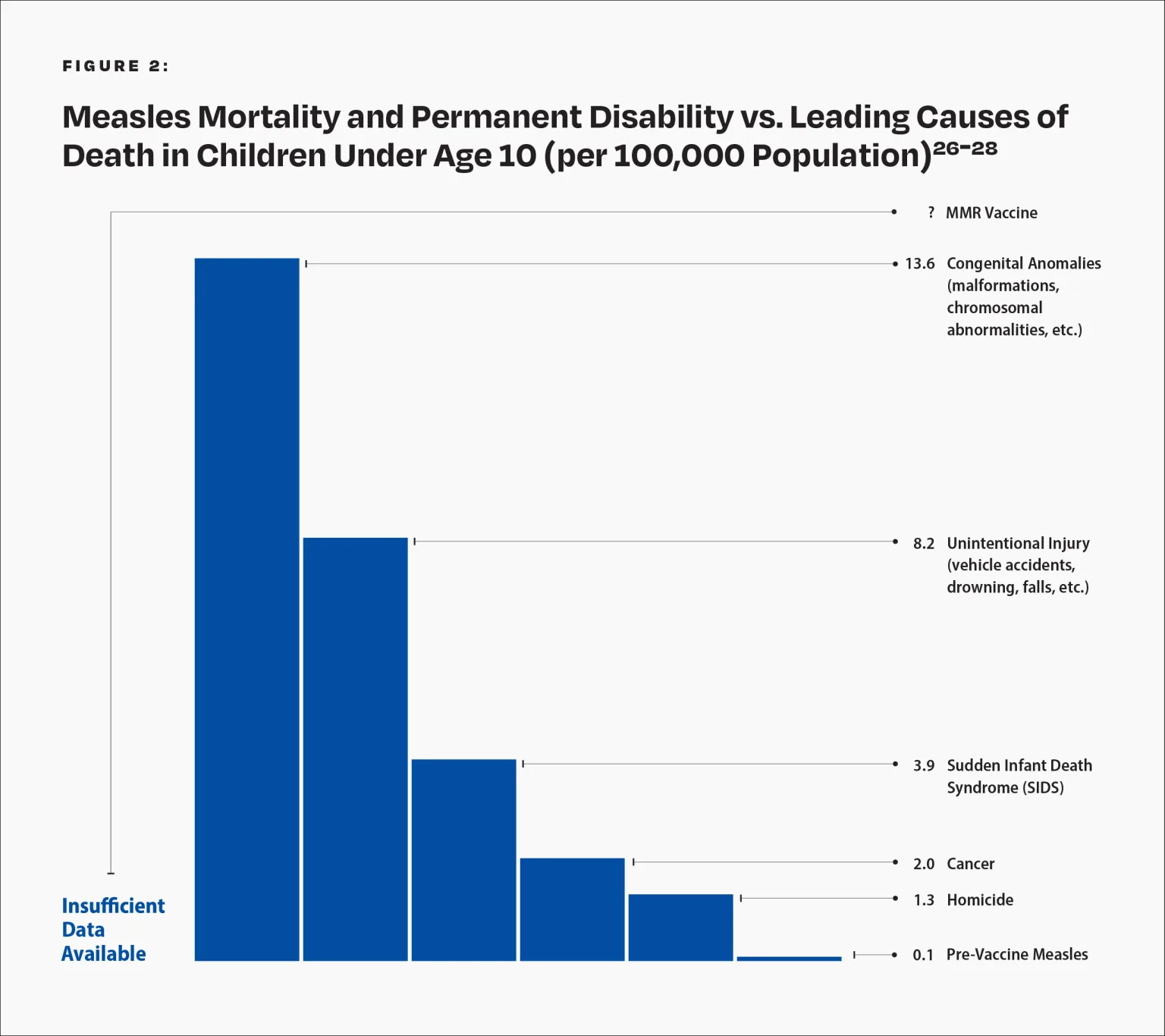
A 0.1% mortality looks really small compared to cancer’s 2%. The difference, of course, is that you can’t get inoculated at birth for cancer. But if you could, would you say, “I’m four times likelier to die in a car accident, so what’s the point?”
No, because the point, obviously, is that fewer kids die. To quote Alexander Langmuir, the author of the aforementioned 1962 paper, “Measles is a disease whose importance is not to be measured by total days disability or number of deaths, but rather by human values and by the fact that tools are becoming available which promise effective control and early eradication.”
No one can say, scientifically, that any one of the 70 vaccine doses currently recommended for American children saves more lives than it costs. That question can only be answered by studies that compare long-term health outcomes in vaccinated versus unvaccinated populations.
When Kennedy says no one can say “scientifically” that a vaccine saves more lives than it costs, he really means no one can say it definitively, with certitude. But we can’t say a lot of things with certitude. I haven’t walked on the moon, so I couldn’t say, definitively, that I would feel lighter on its surface. However, a lot of findings scientifically support the belief that I would feel lighter on the moon. Similarly, many studies scientifically support the belief that the MMR vaccine prevents far more harm than it causes.
In his demand for proof, Kennedy seems reasonable, but really he is asking for the moon. Or, to quote the National Academies, such a large study “would be prohibitively time-consuming and difficult.”
Studies support an unconscionably high injury rate from MMR. Merck’s own MMR pre-licensure studies found that 40% of children receiving the MMR [vaccine] suffered gastrointestinal illnesses within 42 days of the injection and 55% suffered respiratory illnesses — symptoms that might persuade rational consumers to choose the infections over the vaccine.
Here, Kennedy conflates “injury” with the “symptoms” outlined by the 1978 Merck study, which found that “upper respiratory and gastrointestinal infections were reported in about 55% and 40% of vaccinees [in two reviewed groups] respectively.” It also found “a faint measles-like rash” in nine subjects and “mild transient arthralgia" in one. While this sounds scary, these are common side effects of a live vaccination (though less common today), not long-term conditions that we might think of when we hear “vaccine injury.”
26% of post-pubertal females might develop arthritis and arthralgia from the MMR.
More conflation. According to a Johns Hopkins epidemiological review, adult women who took the MMR vaccine developed temporary arthritic and arthralgic symptoms. They did not actually develop arthritis. If my hands ache for a few days after getting the flu, the flu did not give me arthritis; I just had arthritic symptoms that then went away.
A 2004 JAMA study found that an additional 1 in 640 children has seizures after MMR compared to unvaccinated children; about 5% of these will progress to epilepsy.
Again, temporary symptoms (and febrile seizures are not uncommon in infants) are not the same as contracting a condition (here, epilepsy). Kennedy supports his claim with a 2004 JAMA study; this is how it concludes: “MMR vaccination was associated with a transient increased rate of febrile seizures but the risk difference was small even in high-risk children. The long-term rate of epilepsy was not increased in children who had febrile seizures following vaccination compared with children who had febrile seizures of a different etiology.”
HHS’s voluntary post-marketing surveillance program on vaccines, VAERS, reports over 89,000 adverse reactions to MMR through March 31, 2018, including 445 deaths. However, VAERS is a voluntary and notoriously ineffective system. VAERS captures “fewer than 1% of vaccine injuries” according to a 2010 HHS funded study performed by another federal agency, the Agency for Health Care Research and Quality (AHRQ). If you multiply the known adverse events from the MMR by 100, you get 44,500 deaths and 8,900,000 injuries making the measles vaccine far worse than measles.
First, Kennedy gravely misinterprets the VAERS data. Volunteers reported deaths or injuries after vaccination; they didn’t — and really can’t — report causation. They also can’t be closely vetted. In a classic example, Dr. James R. Laidler said he filed a VAERS report that “an influenza vaccine had turned me into The Hulk.” The report remained in the database until VAERS, after a discussion, asked if it could be deleted. So Kennedy’s initial number is invalid.
Second, VAERS captures about 1% of nonserious events, not serious ones. To the contrary, roughly 25% of adverse reactions, like anaphylaxis and Guillain-Barré syndrome, are reported to VAERS. So Kennedy’s multiplication is also invalid, making his claim of 44,500 vaccine-related deaths in 2018 a pure fiction.
Most “anti-vaxxers” are individuals who believe in the traditional liberal axiom that Americans should have sovereignty over their own bodies and that the government has no right to coerce healthy Americans to submit to a risky medical procedure.
Of course, everybody has a right to ask questions and make their own choices. And being nervous about vaccines is reasonable. But having bodily autonomy means having the choice, a choice to cooperate for a higher common good or let your selfish fears persuade you. Kennedy is advocating for your fears, through the language of patriotic idealism — and I can counter with an opposing and equally patriotic story.
After an audacious victory in Trenton in 1776, General George Washington’s ragged Continental Army had to endure a brutal winter in Valley Forge, locked in a battle against an enemy Washington called “ten times more dangerous than Britons, Canadians and Indians together.” That enemy was smallpox, and the weapon Washington chose to fight it was equally audacious: inoculation. Between 1777 and 1778, the forward-thinking Washington ordered a mass inoculation of continental soldiers. As a result, the Continental Army won its battle against smallpox — and, eventually, the war.
In 1777, urgency pushed Washington to supersede bodily autonomy for the sake of a common good — and, ultimately, the very birth of our nation. In 2025, armed with access to a vaccine and information about its benefits, our nation’s choice is not an authoritarian leader’s decision to make between mass bodily autonomy and the common good. Instead, it is an individual choice between that higher good and one's own fear.
You have bodily autonomy; we all do. The achievements of our predecessors granted us that right. Now, we must exercise it wisely.
Take the survey: What do you think of the measles outbreaks? Let us know.
Disagree? That's okay. Our opinion is just one of many. Write in and let us know why, and we'll consider publishing your feedback.
Your questions, answered.
We're skipping the reader question today to give our main story some extra space. Want to have a question answered in the newsletter? You can reply to this email (it goes straight to our inbox) or fill out this form.
Under the radar.
This week, the first in a series of trials scrutinizing the impact of social media on young users began in Los Angeles, California. The plaintiff in the first case is a 20-year-old woman who joined several social media platforms as a child and says she became addicted to them, leading to anxiety and depression. She alleges that these social media companies purposely designed the addictive features and caused direct harm to users. In total, nine cases related to social media and addiction are expected to go to trial in Los Angeles; in another set of cases scheduled for this summer in Oakland, California, school districts and states will argue social media is a public nuisance. The social media companies argue that there is no causal link between social media use and addiction. The New York Times has the story.
You're Probably Overpaying on Amazon
Most Prime members miss built-in tools that lower prices, earn cash back, and cancel forgotten subscriptions automatically.
We compiled 16 lesser-known features that unlock real savings on purchases you're already making — no new apps, no complicated setup. Just a few minutes to stop leaving money on the table.
Numbers.
- 1963. The year the first measles vaccine was introduced.
- 2.6 million. The estimated number of annual deaths globally caused by measles before the vaccine was introduced.
- 59 million. The estimated number of measles deaths prevented by the measles vaccine between 2000 and 2024.
- 95,000. The estimated number of people globally who died from measles in 2024.
- 83%. The percentage of Americans who say the benefits of the measles, mumps, and rubella (MMR) vaccine for children outweigh the risks, according to a May 2025 Annenberg poll.
- 70%. The percentage of Americans who say healthy children should be required to be vaccinated to attend public school because of the potential risk to others who are not vaccinated.
The extras.
- One year ago today we wrote about Trump withdrawing from the Paris Agreement and WHO.
- The most clicked link in yesterday’s newsletter was our Friday edition tracking the Trump presidency.
- Nothing to do with politics: Famed free solo climber Alex Honnold describing how he manages fear.
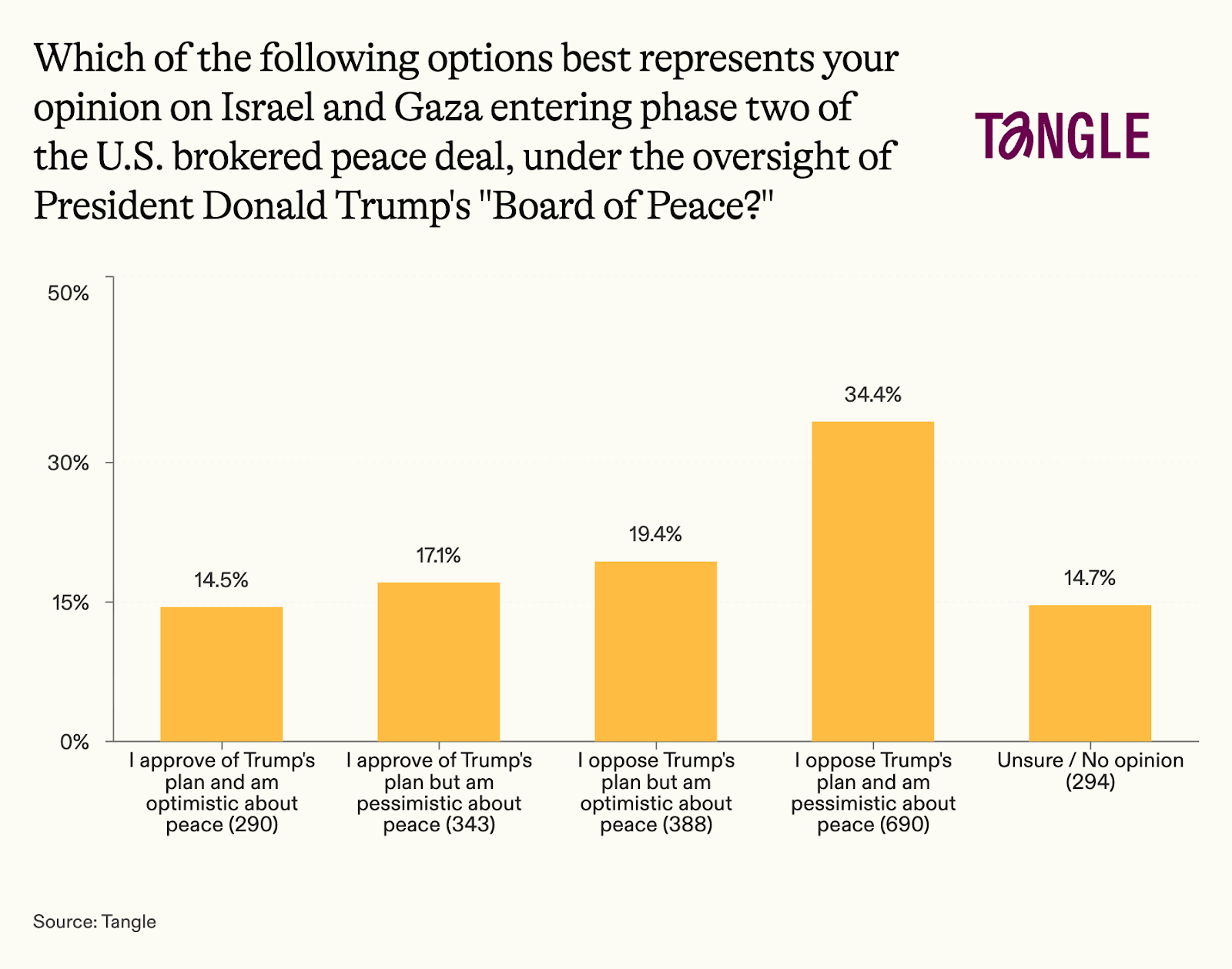
- Yesterday’s survey: 2,005 readers responded to our survey on the Middle East peace deal with 34% opposing Trump’s plan and pessimistic about peace. “I don’t trust the self-dealing. Trump/Kushner will get rich and the Palestinian people will be forgotten,” one respondent said. “I wish there were an option for ‘I’m lukewarm but at least it’s something — let’s give it a go and see what happens,’” said another.
Have a nice day.
Microplastics are one of the most omnipresent environmental pollutants, and reports about their dangers have also been omnipresent. Researchers have detected microscopic remnants in the brain, testes, placentas and arteries, prompting an explosion of research into their detrimental effects. Now, peer reviews of those studies are finding something surprising and equally as far-reaching: false positives. “Fat is known to make false-positives for polyethylene. The brain has [approximately] 60% fat,” said Dr. Dušan Materić at the Helmholtz Centre for Environmental Research in Germany, describing a methodological flaw with one paper. Scientists raised fundamental concerns with other landmark microplastic findings, as well, and The Guardian has the story.

Member comments