One of my favorite things about Tangle is the process that happens before publication — the one our readers and listeners never get to see.
I’ve been thinking a lot about this in recent months: How much debate, dialogue, and discussion goes into everything we publish. How much I learn from the conversations we have pre-publication. How desperately our country needs more of what I believe our staff models every day. I also think a lot about how trust in the media is at an all-time low, and all the innovative ways organizations like ours could try to win that trust back.
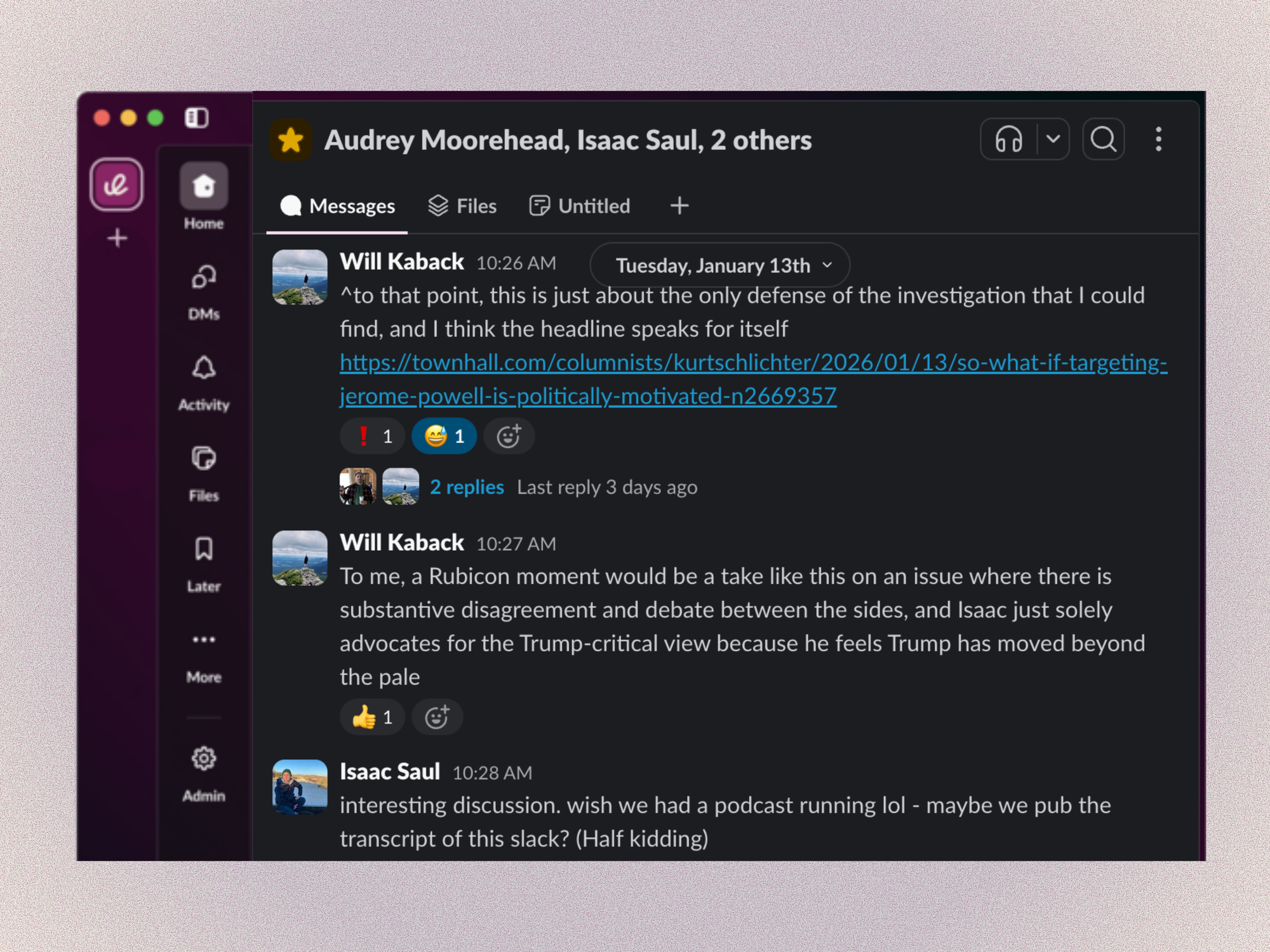
Then, a few days ago, during a discussion in our team Slack channel, I fired off this message:
Internal message, Tangle Slack | Screenshot by Audrey Moorehead
After sending the message, I couldn’t shake the thought. Maybe we should publish a transcript of that conversation.Maybe, actually, showing what happens behind-the-scenes would interest our audience, model civil debate, and help build trust in our brand. In other words: Good content, good citizenship, good business. That’s a win-win-win.
So, deciding I’d ask for permission after the fact, I did something slightly invasive: I started copying and pasting some Slack messages into a Google Doc. I pulled out four exchanges from the past few weeks that I thought would be interesting for our readers to see, and then I told my staff I was going to “leak” them.
The first is a conversation about whether my take on the investigation into Jerome Powell crossed some kind of Rubicon of Trump criticism, and whether I should address that explicitly with our audience. The second is our team’s initial reaction to Associate Editor Audrey Moorehead’s take on the oral arguments from the Supreme Court cases about state bans on trans women in women’s sports. The third is a debate about whether we should officially move The Washington Post editorial board from “left” to “right” (something readers have written in to ask about). And the fourth is the initial conversation about my take on the Minneapolis ICE shooting.
Each of these transcripts reflect the conversations almost exactly as they happened. Nothing has been changed except some punctuation and capitalization for readability (since normal people, unlike our Managing Editor Ari Weitzman, use shorthand and incorrect punctuation in Slack). In a few cases, we also omitted interruptions or asides — for instance, sometimes during a debate or discussion, someone will chime in with a message like, “Sorry to interrupt, but here’s an idea for the subject line of the email.” I’ve left those out. We also decided to note threaded responses — comments responding directly to other messages — as block quotes (as shown below).
Example of threaded-response formatting.
Also, these conversations do not capture nearly all the debate and discussion that we have during newsletter production. Indeed, the bulk of our staff’s back and forth happens inside the Google document where we edit every day’s issue as a team, and that process involves a few more editors who aren’t in our Slack channel. We’ll also have in-person conversations among the editors working side by side in our office, direct messages between individual editors, and occasional calls to discuss more nuanced concerns.
Still, as you’ll see, this is an authentic look into how we discuss and debate the minutiae of our content every day. Below are some very honest, forthright conversations — some exchanges that were so forthright we even considered taking them out — and many things I sincerely doubt other media outlets would ever make public. I’m curious what you all think, if you found this exercise helpful, and any reactions or comments you might have.
DOJ prosecuting Jerome Powell.
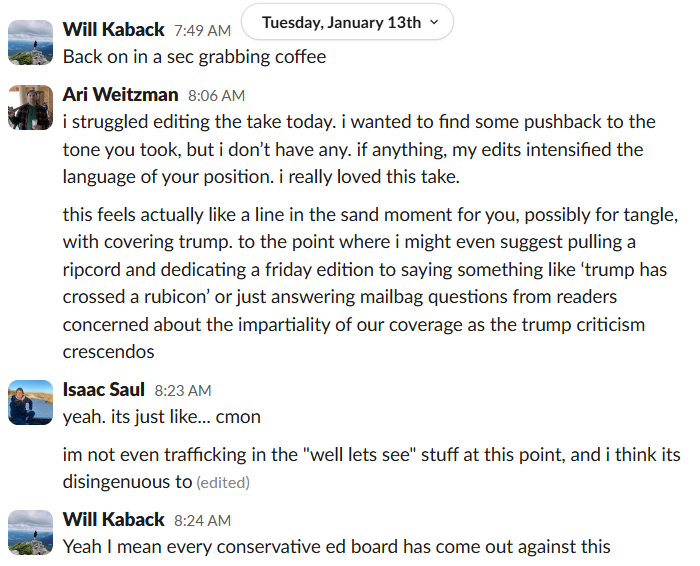
Internal message, Tangle Slack | Screenshot by Audrey Moorehead
After news broke that the DOJ was prosecuting Jerome Powell, I staked out a hardline position in “My take” (which I think has aged well, for whatever it’s worth). 1) I stated plainly that this was an obviously partisan prosecution, and did not entertain alternative theories. 2) I refused to engage with criticisms of Powell, arguing that they were irrelevant to this story. And 3) I shared Powell’s statement, in full, as part of “My take.”
Ari Weitzman (Managing Editor): I struggled editing the take today. I wanted to find some pushback to the tone you took, but I don’t have any. If anything, my edits intensified the language of your position. I really loved this take.
Ari Weitzman (Managing Editor): This feels actually like a line-in-the-sand moment for you, possibly for Tangle, with covering Trump. To the point where I might even suggest pulling a ripcord and dedicating a Friday edition to saying something like “Trump has crossed a Rubicon” or just answering mailbag questions from readers concerned about the impartiality of our coverage as the Trump criticism crescendos.
Isaac Saul (Executive Editor): Yeah, it’s just like… C’mon. I’m not even trafficking in the “well let’s see” stuff at this point, and I think it’s disingenuous to.
Will Kaback (Senior Editor): Yeah I mean every conservative editorial board has come out against this. NY Post, Washington Examiner, and then the ones you'd expect (National Review/WSJ). Meanwhile, The Federalist, Hot Air, PJ Media, etc. have published almost nothing about it — even news articles — which is always telling.
Audrey Moorehead (Associate Editor): I agree with that assessment. The tone of this piece feels different even from past criticisms of Trump. I’m not sure how I feel about it overall — I basically agree with the take, and I don’t think the take should be edited down to become more milquetoast and less honest. Nevertheless, the tone bothers me, and I could see it losing a lot of conservative readers.
Audrey Moorehead (Associate Editor): Of the two approaches you suggested, Ari, I’d favor a reader mailbag version, though I also think we could run a “crossing the Rubicon” piece and then a mailbag in response.
Isaac Saul (Executive Editor): Yeah, I don’t really feel like we need to write some “crossing of the Rubicon” piece, which we already kinda did with “yes things are pretty bad.” I’m happy to answer mailbag Qs about it, but I’d rather just let the take stand on its own. I feel like drawing more attention to it is unhelpful in almost every way.
Ari Weitzman (Managing Editor): On point two, I agree, I don’t want to suggest another piece that just emphasizes today’s take. On point one, honestly, it seems like things have gotten even worse since then — and the posture you’re taking in Tangle is more oppositional to Trump at root. I felt like the moment on [Suspension of the Rules] when you said you don’t think you’ve ever forgiven Trump for [January 6] was informative (for me, and I think for listeners), and I think something that gives you a chance to talk about this stance would be helpful. If today’s survey results [from the Jan. 12 survey on “Donroe Doctrine”] are any indication, we still have a good deal of Trump-friendly and traditional conservative readers we should speak to.
Audrey Moorehead (Associate Editor): ^ I agree with that. I also think that a large amount of our newsletter readers don’t listen to [Suspension of the Rules] and as such your feelings as expressed in the newsletter feel more out of left field — I think you should address those people.
Isaac Saul (Executive Editor): Today’s take didn’t feel Rubicon-y to me which is interesting. Just feel like it’s obvious and a lot of conservative writers stating it plainly. But maybe that’s the point in terms of my perspective.
Audrey Moorehead (Associate Editor): As far as Tangle goes, I think the harshness of your tone here — with no buttresses, moderate qualifiers, etc, and even with an explicit rejection of those moderating qualifiers — is crossing a Rubicon.
Ari Weitzman (Managing Editor): ^^^ Yes, thank you, Audrey. The explicit rejection of the moderation you would have struck in March is what I’m realizing stood out to me.
Lindsey Knuth (Associate Editor): Ifeel like we’ve been beating the drum calling out political prosecutions on both sides — and this one seems particularly egregious, given its effect on the economy and targeting of a clearly reliable figure. It didn’t overly read as a broader castigation of Trump — I'm curious whether our conservative readers would support these charges? I see pro-fed-independence as pretty nonpartisan.
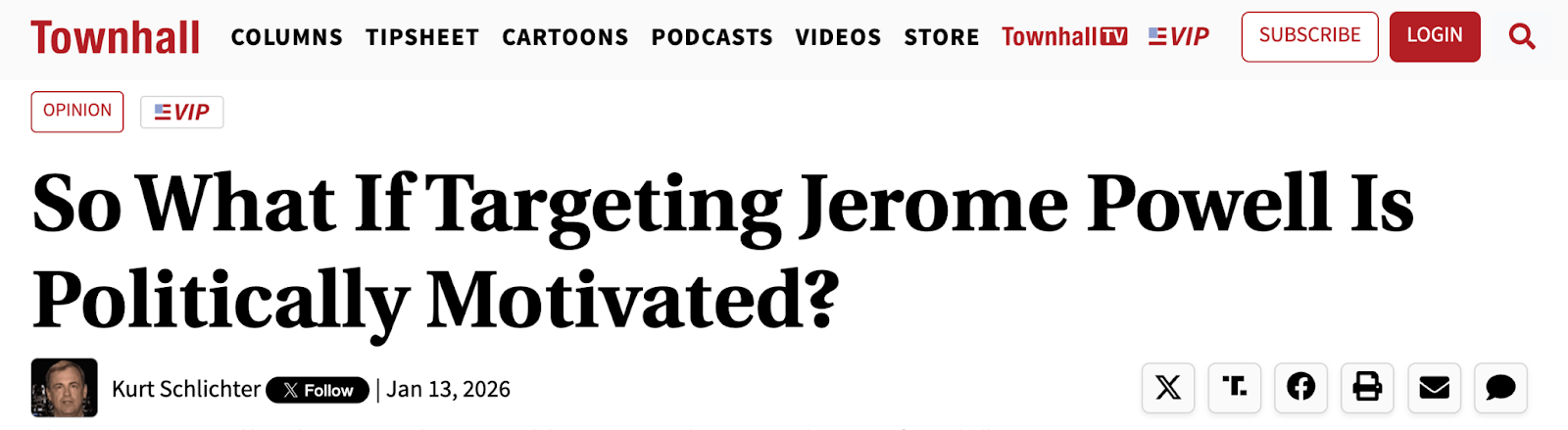
Will Kaback (Senior Editor): ^To that point, this is just about the only defense of the investigation that I could find, and I think the headline speaks for itself:
Will Kaback (Senior Editor): To me, a Rubicon moment would be a take like this on an issue where there is substantive disagreement and debate between the sides, and Isaac just solely advocates for the Trump-critical view because he feels Trump has moved beyond the pale.
Isaac Saul (Executive Editor): Interesting discussion. Wish we had a podcast running, lol — maybe we publish the transcript of this Slack? (Half kidding)
Audrey Moorehead (Associate Editor): Today feels like a Rubicon for me because I think the defining feature of Tangle has long been that, even in moments where it doesn’t make sense, Isaac is willing to add those reasonable discussions about, say, Powell’s tenure — which always reads to me as a peacemaking gesture to those who disagree — but then explains why they’re irrelevant. I also think that today’s take will be more grating for conservative readers presented alongside the reader Q [about Renee Good’s death], which is another situation where I feel like Isaac is usually more moderate but is today being more overt about his moral outrage over the situation.
Ari Weitzman (Managing Editor): That’s a good [perspective], thank you for that. I think I’m getting a sense that the answer to the implied question of “what’s changed” is, “The admin is openly doing political prosecution and openly lying about what its masked quasi-police force is doing, and is ramping up both of these things,” and maybe that’s what’s scratching at me as something to get into explicitly and can explain the stance to conservative readers.
Audrey Moorehead (Associate Editor): Yeah, maybe. But, as someone who does know that that’s the underlying impetus for the change in attitude that's slowly occurring in Isaac’s takes, it doesn’t exactly alleviate the way that the tone grates with me.
Audrey Moorehead (Associate Editor): I do want to make one suggestion, though, which is — to Will’s point about bipartisan condemnation of this — could we explicate that bipartisan condemnation in the take? Right now we mention Republicans who are against the move, but that paragraph is still (rightly) broadly critical of congressional GOP spinelessness. But I think pointing out that even conservative commentators are condemning this will be a relevant point that might soften the take to more right-leaning readers — I can make a suggestion [in the draft], I think it could go in the very graf where Isaac says there’s no need to include the discussion about Powell
Lindsey Knuth (Associate Editor): Like the suggestion Audrey — I think it could go in a few different places, but works where you put it
Isaac Saul (Executive Editor): I like Audrey’s suggestion. We could even add what Will said — that some places just straight up ignored it?
Ari Weitzman (Managing Editor): I think that’d be very powerful. For what it’s worth, I think we can do more with this section about why this is different to you and lengthen it if we wanted to. NOT BY A TON, but we are currently under 4400 [words].
Isaac Saul (Executive Editor): Added something.
Ari Weitzman (Managing Editor): Looks great. Small edits from Audrey and me.
SCOTUS ruling on banning trans athletes from women’s sports.
Internal message | Tangle Slack, screenshot by Audrey Moorehead
On Wednesday, we covered the oral arguments on state-level bans of trans girls and women in women’s sports before the Supreme Court. As in much of the country, trans issues divide our staff and evoke a lot of sensitive conversations. This time, Audrey penned the take. She tends to have more cautionary, conservative values on issues like this, while I’ve long taken a more libertarian position. Other editors, like Lindsey Knuth, view the issue through a more progressive lens. Audrey is also still in the early days of writing takes and carving out her voice in Tangle, so our conversation was not just about the debate at hand but also how well she was communicating her position and defining her values to our audience.
This post is for paying subscribers only
Sign up now and upgrade your account to read the post and get access to the full library of posts for paying subscribers only.