
I'm Isaac Saul, and this is Tangle: an independent, nonpartisan, subscriber-supported politics newsletter that summarizes the best arguments from across the political spectrum on the news of the day — then “my take.”
Are you new here? Get free emails to your inbox daily. Would you rather listen? You can find our podcast here.
Today’s read: 15 minutes.
Correction.
In yesterday’s edition about the State of the Union, when writing about Trump’s description of the death of Iryna Zarutska, we wrote that she was stabbed on a bus in Charlotte, North Carolina. In fact, she was attacked while riding the light rail train. This was a factual error in the take that escaped our notice during editing. Thank you to the reader who pointed it out.
This is our 152nd correction in Tangle’s 342-week history and our first correction since February 18. We track corrections and place them at the top of the newsletter in an effort to maximize transparency with readers.
The politics of the Olympics.
Yesterday, when Kmele, Ari and I sat down to record our weekly Suspension of the Rules podcast, we spent a lot of time discussing the Olympics. In my opinion, this year’s Olympics was an awesome, unifying experience. The U.S. athletes were incredible, people like Alysa Liu were able to transcend sports, and no moment could crack that two-week feeling of national unity — right up until the end. In tomorrow’s Friday edition, Managing Editor Ari Weitzman’s writing about the controversy over the U.S. men’s hockey team, and why it shouldn’t fracture the pride we should all share in American sports.
Quick hits.
- Cuban soldiers killed four people and wounded six others in an incident off the country’s coast, according to Cuban officials. The government said that those killed and wounded were in a Florida-registered speedboat and opened fire on Cuban soldiers, injuring one. The alleged assailants are believed to be Cuban nationals living in the United States, but Secretary of State Marco Rubio said the U.S. is gathering its own information. (The incident)
- The Senate Health Committee held a confirmation hearing for Casey Means, a physician and wellness influencer who is President Donald Trump’s nominee for surgeon general. Lawmakers questioned Means about her stance on vaccines and autism, as well as her advocacy for the “Make America Healthy Again” agenda. (The hearing)
- Iran and the United States are holding a third round of indirect talks on Iran’s nuclear program. Ahead of the talks, Secretary of State Rubio said Iran’s refusal to discuss its ballistic missile program was a “major problem,” while an Iranian foreign ministry spokesperson said the country is approaching the talks with “seriousness and flexibility.” (The talks)
- A federal judge ruled that the Trump administration cannot deport noncitizens to countries to which they have no existing connection, that noncitizens must receive adequate notice of removal, and that they have an opportunity to challenge the decision. (The ruling)
- Microsoft co-founder Bill Gates apologized to the Gates Foundation’s staff over his relationship with convicted sex offender Jeffrey Epstein but denied any criminal wrongdoing. Gates also admitted to having two affairs while he was married, but said they did not involve Epstein’s victims. (The apology) Separately, former U.S. Treasury Secretary Larry Summers announced his resignation from his professorship at Harvard University amid scrutiny of his relationship with Epstein. (The resignation)
Today’s topic.
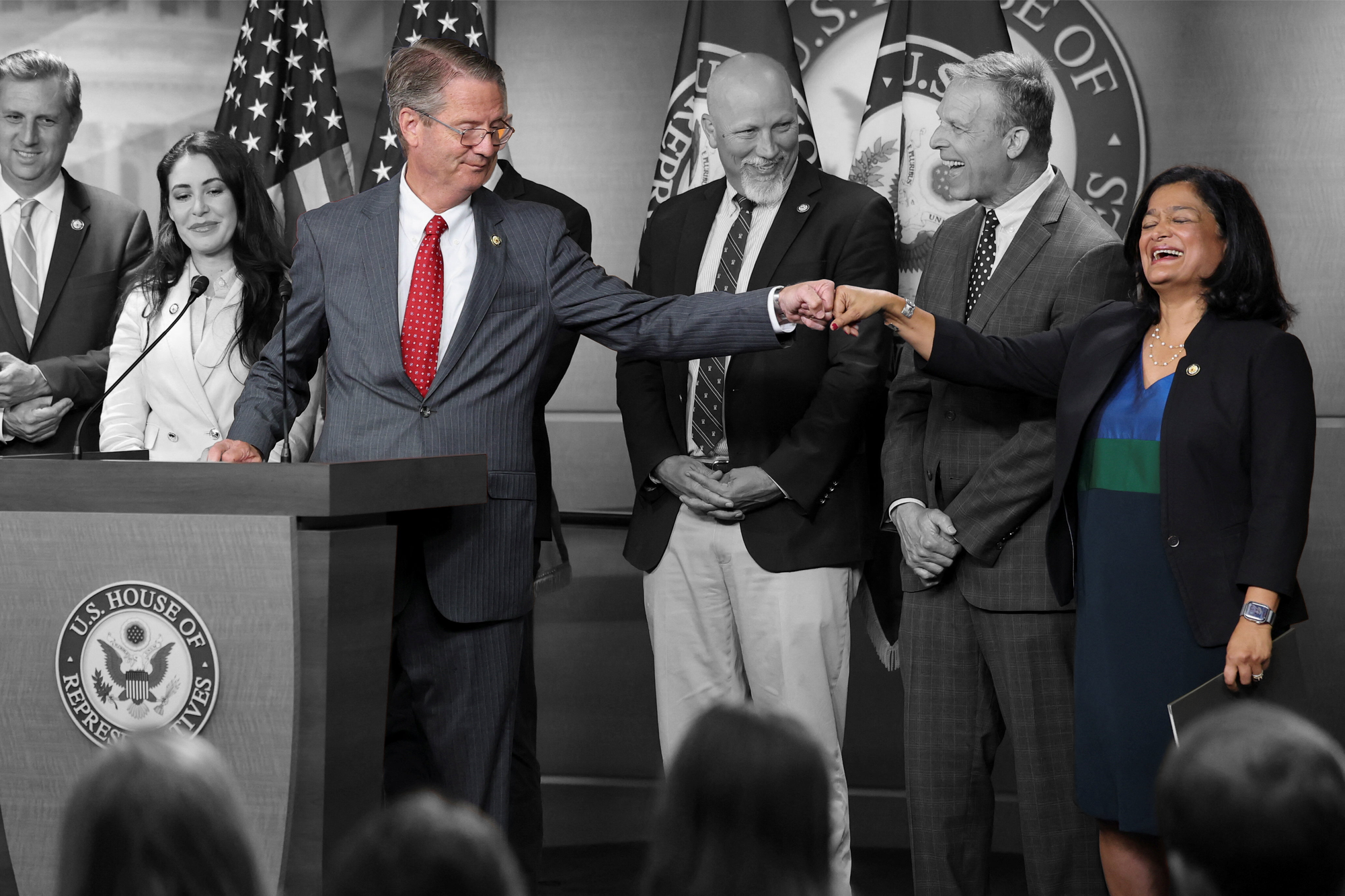
Bans on Congressional stock trading. On Tuesday, in his State of the Union address, President Donald Trump called on Congress to pass the Stop Insider Trading Act (SITA), a bill that would bar members of Congress and some immediate family members from trading individual stocks. The line led to one of the few instances of bipartisan applause during Trump’s speech, and the president’s reference renewed discussions over efforts to curtail lawmakers’ trading.
What’s in the bill: Rep. Bryan Steil (R-WI) introduced SITA in January, and it has been referred to the Committee on House Administration. Under the current text, any member of Congress, their spouse, and their dependent children would be prohibited from purchasing individual publicly traded stocks and must provide 7–14 days of public notice before selling stocks, options, and warrants. However, the bill would allow members of Congress to invest in diversified funds. Those found in violation would face a penalty of $2,000 or 10% of the transaction’s value (whichever is greater).
Currently, Congressional stock trading is regulated by the 2012 Stop Trading on Congressional Knowledge (STOCK) Act, which prohibits members of Congress, their staff, and executive branch officials from using non-public information for personal gain. The law also requires members of Congress to disclose stock trades of more than $1,000 within 45 days. However, critics have said that the law is regularly violated and lacks sufficient deterrence measures, calling for additional legislation to address trading loopholes.
The Stop Insider Trading Act is just one of several similar bills introduced this Congress. Also in January, Rep. Zachary Nunn (R-IA) introduced the No Corruption in Government Act, which would ban members of Congress and their spouses from trading stocks (but allow them to use qualified blind trusts). Other examples include the End Congressional Stock Trading Act introduced in March 2025, the Halting Ownership and Non-Ethical Stock Transactions Act introduced in April 2025, and the Restore Trust in Congress Act introduced in September 2025. Many of these bills have Democratic cosponsors, but none of them have advanced to a vote in either chamber.
These legislative efforts follow increased scrutiny of lawmakers’ stock trading. A 2022 New York Times analysis found that, between 2019 and 2021, 97 lawmakers or their family members bought or sold financial assets while sitting on committees that potentially gave them influence over industries affected by their trades. The report flagged over 3,700 total trades during this time period that raised potential conflicts of interest.
Today, we’ll survey arguments on Congressional stock trading bans, with views from the left and right. Then, Managing Editor Ari Weitzman gives his take.
What the left is saying.
- The left supports Congressional stock trading bans, though many push for reform stricter than the bill Trump endorsed.
- Some say lawmakers shouldn’t be allowed to trade even if they aren’t benefitting from privileged information.
- Others note how common stock trading is among both parties’ representatives.
In USA Today, Chris Brennan argued “Trump’s State of the Union insider trading push isn’t reform.”
“It felt incongruous, a wealthy politician like Trump calling for reform in how members of Congress profit in the stock market. Here was Trump, presenting a worthy idea with broad support from the public. But the more you know about what Trump wants, the less impressive it gets,” Brennan wrote. “The legislation he touted in his speech is, at best, reform-light and, at worst, just more self-dealing disguised as reform. The Stop Insider Trading Act… is opposed by exactly the kinds of good-government groups that support reform in how members of Congress trade stocks.”
“[These groups] noted that the Stop Insider Trading Act ‘does not ban members of Congress from owning stock, profiting from stock trades or making decisions that would increase the value of their stock portfolio that they hold.’ That legislation, the groups added, also allows stock purchases of private companies, cryptocurrencies, corporate bonds and other financial instruments,” Brennan said. “The Restore Trust in Congress Act, by contrast, ‘effectively bans members of Congress from buying, selling and owning stocks and their equivalents and ends the conflict of interest that have plagued Congress for too long.’”
The Bloomberg editorial board said “Congress has no good excuse to keep trading stocks.”
“It’s a poor look for legislators to be buying and selling stock in companies over which they hold sway. In recent years, analyses have found that 97 lawmakers had bought or sold stock in companies that intersected with their committee work, including more than a dozen members who oversaw the Pentagon and had financial ties to defense contractors,” the board wrote. “Efforts by lawmakers to regulate themselves have not been notably successful. In 2012, they passed the Stock Act to require that trades worth more than $1,000 be disclosed within 45 days. Yet members have routinely failed to comply with the requirement.”
“There’s no reasonable defense for this. After all, owning low-cost index funds should under normal circumstances be far preferable to dabbling in individual stocks… And restrictions on personal trading are hardly unusual in industries — such as finance and the news media — that are keen to prevent conflicts of interest and preserve customers’ trust,” the board said. “A seat in Congress comes with many privileges. Day trading shouldn’t be one of them.”
In Jacobin in 2022, Branko Marcetic wrote “Congress is day-trading while the world burns.”
“The way US politicians talk about their country, you’d be forgiven for thinking that American society is a business. And the way they buy and sell shares, you’d be forgiven for thinking Congress is less a deliberative body for crafting laws than an extension of the stock market,” Marcetic said. “House Speaker Nancy Pelosi (D-CA), who just recently defended Congressional stock trading by arguing the United States is a free market economy, continues to lead the field in options trading, having bought $12.75 million worth of options contracts in 2021.”
“Should the push for a full ban be actually serious and successful, it will only be one small step in ending the open corruption of the US political system. Members of Congress will still continue to be bribed with campaign contributions and corporate jobs, while US politics continues, logistically, to be almost exclusively limited to the wealthiest strata of society — the very people most likely to trade in stocks and otherwise invest on the side as they set public policy,” Marcetic wrote. “Still a law banning the practice is long-since needed, and would be more than welcome.”
What the right is saying.
- Many on the right support the proposed bans, saying they are key to restoring trust in Congress.
- Some say evidence of lawmakers making unethical trades is scarce.
- Others suggest any ban must be part of a broader oversight effort.
In The Washington Examiner, Dylan Hedtler-Gaudette wrote “ban congressional stock trading.”
“There are few things more damaging to public trust in our democracy than the perception that lawmakers are lining their own pockets at the expense of the people they serve. For years, the public has watched both Republican and Democratic members of Congress buy and sell individual stocks, sometimes right before key legislation moved or damaging reports broke. It’s not just a bad look but also a glaring ethical failure,” Hedtler-Gaudette said. “Insider knowledge about upcoming regulations, committee decisions, industry trends, or national security developments gives elected officials a leg up in ways that an average citizen cannot hope to match.”
“The solution is clear: Require lawmakers to divest from individual stocks or place them in a blind trust while serving in office. This is not an extreme position. In fact, it’s supported by an overwhelming majority of people,” Hedtler-Gaudette wrote. “Cynicism is spreading, especially among those who see Washington as a place where one set of rules is written for average people and another for the powerful. Passing a ban on congressional stock trading would be a significant step toward rebuilding the public’s faith in our institutions.”
The Wall Street Journal editorial board said “let voters judge Congress’s stock trading.”
“The 2012 Stock Act already prohibits Congress from trading on nonpublic information. If that law needs stronger oversight or enforcement, fine. Transactions over $1,000 are publicly disclosed, and constituents are always free to fire a Congressional day trader,” the board wrote. “Only about half the Senate and a third of the House held individual stocks last year, according to a Journal analysis. But voters can judge if that’s disqualifying. President Trump didn’t divest his assets to resolve business conflicts, and the public put him in office anyway.
“There are 535 Members of Congress, so even if they were trading randomly it wouldn’t be too hard to find some transactions that could look bad. News stories promising scandal sometimes note deep into the text that the politician in question says the portfolio is run by some outside financial adviser,” the board said. “An academic study of Congressional trading from 2012 through 2020 found ‘no evidence of superior investment performance’ but returns ‘consistent with random stock picking.’”
In The Portland Press Herald, Jim Fossel called trading bans “tricky — and necessary.”
“[The proposed bans] don’t apply to other people who are very close to members. That includes mistresses — which, of course, typically isn’t public knowledge — but also college roommates, lawyers, golf buddies, uncles, you name it,” Fossel wrote. “Again, a member of Congress already can’t pass along insider information to any of these people, so a sweeping ban on them is both unnecessary and legally untenable. Just like with the COVID trades, it’s already illegal for a member of Congress to share insider information with any of those people; it’s just difficult to prove.”
“The ban on congressional trading is of a similar variety, but it’s also so specifically and narrowly tailored that it’s easy for people to get around,” Fossel said. “These proposals also do not cover the president, vice president or the executive branch, nor do they cover congressional staff. Those people can have just as much access to inside information, or more, as members of Congress. That’s not a reason to oppose this pending legislation, however: they could be covered by future proposals.”
My take.
Reminder: “My take” is a section where we give ourselves space to share a personal opinion. If you have feedback, criticism or compliments, don't unsubscribe. Write in by replying to this email, or leave a comment.
- The incentives in place open the door to easy corruption and profiteering.
- Existing laws don’t work, and the proposed reforms are either no better or will never pass.
- If we actually want to reform Congress, we need to change the incentives.
Managing Editor Ari Weitzman: Among my college friends, the dogma of our university’s School of Economics was something of a meme: “People respond to incentives.” That was the credo that allowed Freakonomics author and University of Chicago economics professor Steven Levitt to argue that we should pay kids for doing well on their SATs and should not fine parents for picking their children up late from daycare. It allowed us undergraduates to argue (only somewhat ironically) that we should make beer available for free at our parties, and — if we were getting tired anyway — we should leave class early. Then, as we got older, we used it almost double-ironically to justify selfish decisions we make as individuals, even if we know the consequences of those decisions on a larger system aren’t great.
Drive there because the bus takes longer. Purchase the cheaper, fast-fashion pair of jeans. Maybe even buy stock in your friend’s company when you hear (privately) they’re getting acquired. You shouldn’t, but nobody would really notice a purchase this small, and it’s a guaranteed buck. “People respond to incentives.”
And the incentives for Congress are never going to stop lawmakers from profiting on their offices — unless they’re offered something valuable in return. That may be too cynical a take for Tangle, but let’s be realistic, here. Rep. Tom Suozzi (D-NY) netted a 35% return on stocks after entering Congress; his net worth chart is a mockery of civic responsibility. But he may not be as bad as Rep. Rob Bresnahan (R-PA), who campaigned on banning stock trading and yet has become one of the freshman class’s most active traders. When confronted on this apparent hypocrisy, Bresnahan’s response was almost the same as Rep. Nancy Pelosi’s (D-CA): “I never trade my own stocks.”
I lived in Pelosi’s district in the Bay Area for a number of years, and I remember going to her office once as a constituent. I’ll never forget a picture on display in her waiting room: she and her daughter, surrounded by fog in the middle of the Golden Gate Bridge, with no cars or pedestrians in frame. Can you imagine the kind of influence a person must have to use the Golden Gate Bridge — perhaps the country’s most important mile-long stretch of roadway — for a private photo shoot? The image conveyed something important to people like me who were hoping for a minute of her time: The person who occupies this office wields immense power, and she isn’t afraid to do so to her benefit.
Obviously, it’s a problem if our representatives can use their office for personal gain. That is the textbook definition of corruption — it allows people whose job it is to look out for the national interest to also weigh what might benefit them. As it is now, public office presents too inviting an opportunity to profit from the information that circulates the halls of Congress for us to blithely hope our representatives won’t capitalize on their stations.
People respond to incentives. About a third of Congress reported trades by themselves or immediate family members between 2019 and 2021, and over half of them — 97 lawmakers — served on committees that could have informed those trades. And those are just the ones we know about. Sen. Markwayne Mullin (R-OK) failed to disclose hundreds of trades for a year; which makes sense, since the existing penalty under the STOCK Act for violating disclosure requirements is a $200 fine. That law also has steeper civil forfeiture penalties and jail time for insider trading, but those theoretical penalties may, bizarrely, be too strong. No member of Congress has ever been prosecuted under that law, including those who made lucrative trades after receiving privileged information during the Covid-19 pandemic — which could just as easily be proof that the kind of insider training the STOCK Act bans is simply too hard to prove.
Either way, a law that severely punishes only certain kinds of stock trades clearly isn’t working. And again: The people who came to Congress under this incentive structure — many of whom have accumulated net worths safely into the seven-figure range — aren’t going to vote for a change that would actually restrict themselves. Or, as Sen. Ron Johnson (R-WI) said, he won’t support a law that would make running for office “unattractive.”
To be fair, I don’t think Johnson’s view represents the majority opinion in Congress. Still, the bills his colleagues have proposed to address this issue lack teeth. The one President Trump supports — the Stop Insider Trading Act — only applies to Congress, does not require divestment, and fails to prevent members of Congress from profiting off trades. As such, that bill is opposed by many pro-reform advocacy groups. The law most favored by those groups is the Restore Trust in Congress Act, which requires divestment of assets, bans new purchases, and would penalize any violators with profit forfeiture. It has some problems — family members whose “primary occupation” is trading stocks are exempted, family trusts provide a potential workaround, and we still can only hope that the law would actually be enforced — but it’s the best of the current reform options.
And it’s never going to pass. House Speaker Mike Johnson (R-LA) won’t let that bill reach the floor because “You don't want another deterrence for good people running for office.”
People respond to incentives. If you want to actually restrict stock trading and the wide-open path to personal enrichment it provides, any meaningful restriction on that path has to — as disgusting as this sounds — broaden another. My proposal is immensely unpopular; I think it’s the most unpopular position of all my political opinions: We should give every member of Congress a raise, conditioned on passing a strict ban on trading. Their salary right now is $174,000, plus incredible health benefits. I say it should be $300,000, a final tax hit on the American people of $54 million (about 0.00077% of the federal budget, or about a fifth the cost of one military aerial refueling tanker).
I know, giving Congress more money doesn’t sound like a great solution to the problem of them making too much money. But think about it: If you make it easier for elected officials to make money by simply doing their jobs, then the draw of stock trading isn’t so alluring. And to Speaker Johnson’s point, if you raise the salary for a position, you attract the best candidates. If any stock-trading ban is connected to a substantial pay raise, then how could any member of Congress possibly complain that it would be a “deterrence for good people running for office”?
Banning stock trading is an idea whose time has come. But if we could ever dream of the group of people who currently occupy our federal legislature passing such a reform, it has to come with incentives they will actually respond to. Ban stock trades, enforce the laws, give Congress a raise, and encourage the best people — not the people who are best at leveraging their power — to run for office.
Take the survey: How do you think Congressional stock trading should be reformed? Let us know.
Disagree? That's okay. Our opinion is just one of many. Write in and let us know why, and we'll consider publishing your feedback.
Thanks for reading today's edition. If you want to unlock members-only content and support our mission, consider becoming a Tangle member here.
Your questions, answered.
Q: Your analysis of the tariffs decision gives too much weight to major questions. Why does this precedent get so much deference when it did not exist prior to the makeup of this SCOTUS?
— Bob (submitted through our texting service Subtext)
Tangle: First, let’s define our terms: Broadly, the major questions doctrine is a Supreme Court test for executive branch actions that have not been explicitly delegated by Congress. When the Court applies the major questions doctrine, it first reviews whether the standard under its review constitutes a “major question” with broad economic or political significance. Then, it considers whether an action taken by the president or by an executive agency (such as the Environmental Protection Agency) was clearly delegated to the executive branch by Congress.
Judges and scholars who favor the doctrine argue that only Congress has the power to issue broad rules and regulations, and that Congress’s delegations to the executive branch must be clearly defined. Critics of the test argue that broad application wrests interpretive power away from the executive and undermines the clear Congressional authority granted to various agencies.
Yes, the major questions doctrine has only recently become routinely applied by the Supreme Court, but it did exist before the Roberts Court. And while it is mostly applied by the Court’s conservative justices, it isn’t only a conservative principle.
According to a Yale Law Journal review, the major questions doctrine was first raised as a potential legal test by none other than former Democrat-appointed Supreme Court Justice Stephen Breyer, in an article he penned while serving as a U.S. Circuit Court judge. Breyer’s initial theory was relatively narrow; he argued that courts should first consider the weight of a legal question before deciding whether to defer to an agency’s interpretation of a statute. The Supreme Court then used a version of Breyer’s doctrine for the first time in MCI Telecommunications Corp. v. AT&T (1994), just one month before President Bill Clinton nominated him to the Supreme Court. Breyer sometimes applied and sometimes rejected the major questions doctrine while on the bench — most notably, he dissented from a 1999 decision in which the majority opinion cited his own article.
Some scholars argue that there are two major questions doctrines — the first, a narrower principle that’s in line with regular statutory interpretation; and the second, a much more expansive form of judicial review that has developed as the Roberts Court has become increasingly restrictive of executive power, such as through its overturning of Chevron in 2024. No matter how you parse it, though, many current Justices find the major questions doctrine to be a useful tool to interpret when the executive branch is overreaching.
Want to have a question answered in the newsletter? You can reply to this email (it goes straight to our inbox) or fill out this form.
Under the radar.
On Tuesday, NPR reported that the Department of Justice (DOJ) withheld or removed documents in its release of millions of files related to convicted sex offender Jeffrey Epstein that mentioned President Trump, including notes from a Federal Bureau of Investigation interview with a woman who claimed Trump sexually abused her when she was a minor. The report comes as the DOJ denies claims that it withheld records to protect public officials or other individuals, saying that the remaining unpublished files are privileged, duplicates, or relate to an ongoing federal investigation. However, on Wednesday, it said it is reviewing whether any documents containing mentions of Trump were improperly withheld. Democrats on the House Oversight Committee also announced an investigation into the report. NPR has the story.
Numbers.
- 25. The number of measures introduced in the 119th Congress to limit or bar lawmakers, their spouses and dependents, and/or other Congressional employees from engaging in certain financial activities, according to testimony before the Committee on House Administration in November 2025.
- 1,200. The approximate number of late STOCK Act disclosures (from 40 lawmakers) in 2025, according to Unusual Whales’s Congress Trading Report.
- 32%. The percentage of lawmakers whose stock portfolios outperformed the SPDR S&P 500 ETF Trust’s return in 2025.
- $170 million and $125 million. The total value of the stocks that lawmakers sold and bought, respectively, in 2025.
- 86%. The percentage of registered voters who support bans on members of Congress trading stocks in individual companies, according to a May 2023 Program for Public Consultation poll.
- 87%. The percentage of registered voters who support bans on the president, vice president, and Supreme Court justices trading stocks in individual companies.
The extras.
- One year ago today we wrote about Kash Patel and Dan Bongino.
- The most clicked link in yesterday’s newsletter was the Supreme Court’s ruling about the Postal Service.
- Nothing to do with politics: The incredible engineering behind mechanical pencils and other household items.
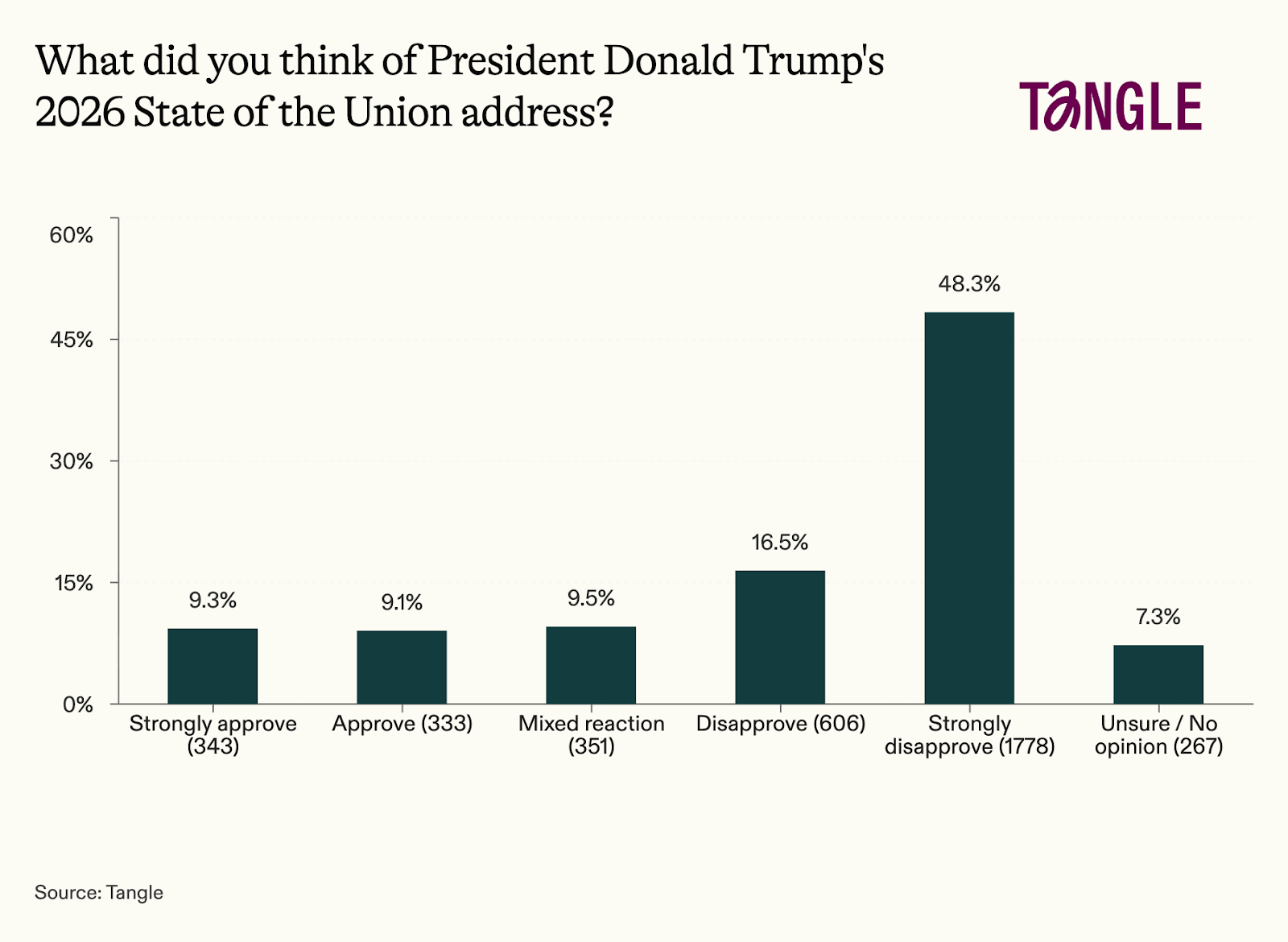
- Yesterday’s survey: 3,678 readers responded to our survey on President Trump’s State of the Union address with 65% disapproving. “This was not a unifying speech. It was malicious and exaggerated and on many topics dishonest,” one respondent said. “I love my country, and I felt it even more after Trump’s address last night,” said another.
Have a nice day.
Over the six semesters (and counting) that Tangle’s college ambassador program has been active, its footprint has steadily increased. In the fall 2023 semester, the program launched with a cohort of three students; this semester, it has 45. One student, Sam Fournier, has focused his efforts on adapting the Tangle coverage model to a campus setting, starting an official Tangle club at George Mason University. In Fournier’s words, “The goal is to establish a common ground based on the facts, and to come together to hear other people’s ideas” by engaging with students of different political views, majors, and upbringings. Renata Pernegrova (another Tangle college ambassador) profiled the club in Fourth Estate, and you can read it here.


Member comments