
I'm Isaac Saul, and this is Tangle: an independent, nonpartisan, subscriber-supported politics newsletter that summarizes the best arguments from across the political spectrum on the news of the day — then “my take.”
Are you new here? Get free emails to your inbox daily. Would you rather listen? You can find our podcast here.
Today’s read: 16 minutes.
We’re hiring.
Applications are open for a part-time role on the Tangle editorial team. This remote position will involve in-depth research and editing work on the daily newsletter, as well as opportunities to contribute to our podcast, YouTube, and social media channels. We are accepting applications until Tuesday, February 10 at 11:59 PM ET. To learn more about the position and how to apply, click here.
Quick hits.
- A partial government shutdown began on Saturday after Congress failed to pass a funding package by the Friday deadline. The Senate passed a $1.2 trillion bipartisan bill 71–29 to fund most agencies through September, while extending Department of Homeland Security funding for two weeks to allow lawmakers more time to negotiate a longer-term package for the department. The bill now goes to the House, where Speaker Mike Johnson (R-LA) said he will attempt to fast track the bill and pass it by Tuesday. (The latest)
- The Justice Department released over 3 million pages of files related to the government’s investigation of convicted sex offender Jeffrey Epstein. The latest release contains references to prominent public figures and politicians mentioned in past releases, including President Donald Trump, former President Bill Clinton, and businessman Elon Musk. (The release)
- A federal judge denied Minnesota’s request for a temporary injunction to stop the federal immigration enforcement operation in the state, finding the state had not met the burden of proof necessary to justify an injunction. (The ruling)
- Former Harris County Attorney Christian Menefee (D) defeated former Houston City Council Member Amanda Edwards (D) in a special runoff election to serve the remainder of Rep. Sylvester Turner’s (D) term after he passed away in March 2025. Filling the seat will shrink Republicans’ House majority to 218–214. (The result)
- President Trump said that the Kennedy Center in Washington, D.C. will close for approximately two years for repairs and renovations. Several artists have cancelled performances at the cultural center since Trump took control of its board and operations. (The announcement)
Why We’re Subscribed To Brad’s Deals.
Yeah, you probably use Amazon… but do you actually use Amazon?
Brad (yep, he’s a real guy) was a broke college student finding cheaper ways to shop and sharing them with his friends. And thus… Brad’s Deals was born.
Brad’s Deals cracks open the lid on a Pandora’s box of deals you probably knew nothing about. You can maximize the value of your Amazon Prime Membership by uncovering 9 lesser-known benefits that can transform your shopping, streaming, and saving experience.
Get all the deals from Brad’s Deals by signing up for free with your email address. Happy shopping!
Today’s topic.
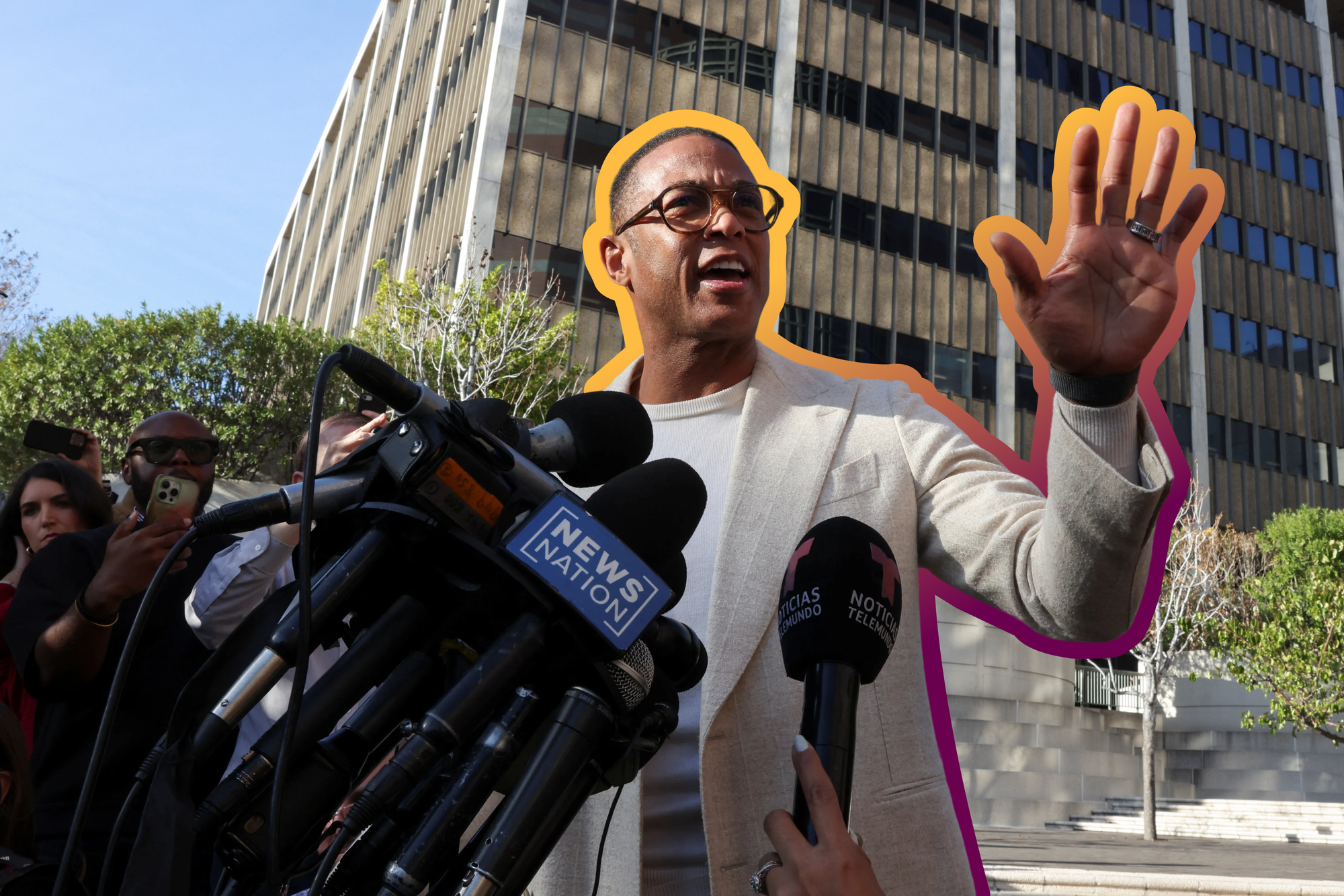
The charges against Don Lemon. On Thursday night, former CNN anchor and independent journalist Don Lemon was arrested in Los Angeles and charged with federal civil rights violations for his alleged actions at a protest inside a Minnesota church in January. The Department of Justice charged Lemon, activist Nekima Levy Armstrong, Minnesota-based journalist Georgia Fort, and six others with conspiracy to interfere with the civil rights of church congregants and with violating the federal Freedom of Access to Clinic Entrances (FACE) Act. Lemon, who has maintained that he was covering the protest as a journalist, was released without bond after appearing in federal court on Friday afternoon. His next hearing is scheduled for February 9 in Minneapolis.
Back up: On January 18, a group of protesters interrupted church services at Cities Church in St. Paul, Minnesota, in response to reports that one of the church’s pastors works as an Immigration and Customs Enforcement (ICE) official. The protest is part of a broader pushback against ICE in Minneapolis, which was amplified after the fatal shooting of U.S. citizen Renee Good by an ICE agent in the city on January 7. Lemon livestreamed the protest and preparations in a parking lot near the church. “This is an operation that is secret,” Lemon said on the livestream, “I can’t tell you what’s going to happen, but you’re going to watch it live unfold here.” Lemon then walks into the church along with the protesters, who move towards the front of the main aisle chanting “Justice for Renee Good” and “Hands up, don’t shoot.”
Prosecutors allege Lemon and other co-defendants “oppressed, threatened, and intimidated” congregants and pastors by occupying the main aisle and “engaging in menacing and threatening behavior.” They further claim Lemon physically obstructed congregants from exiting the building by “posting himself” at the main door. Lemon can be seen throughout the video asking congregants and protesters for interviews, and he says at times that he is there as a journalist and unaffiliated with the protest.
Federal prosecutors first brought the criminal complaint to a federal magistrate judge, who declined to approve the charges against Lemon and four others, citing insufficient evidence. Then, after Minnesota Chief U.S. District Judge Patrick Schiltz refused to immediately intervene, the Justice Department sent the U.S. Court of Appeals for the Eighth Circuit an emergency petition, which the three-judge panel rejected. Finally, on Thursday, prosecutors presented the case to a Minnesota grand jury, which returned the indictment that led to Lemon’s arrest.
On his YouTube show after his release, Lemon called the charges an attempt by the federal government to “silence journalists.” The Foundation for Individual Rights and Expression released a statement on Friday criticizing the charges, writing, “Journalists play a vital role in documenting and reporting on events of public concern, including illegal conduct,” and “manufacturing federal crimes out of the facts we’ve seen so far chills that core function.”
Below, we’ll get into what the left and right are saying about the charges against Lemon. Then, Executive Editor Isaac Saul shares his take.
What the left is saying.
- The left is critical of Lemon’s arrest, which many call the latest Trump-led political prosecution.
- Some say the legal basis of the charges is weak.
- Others suggest the arrest will catalyze further opposition to Trump.
In Bloomberg, Nia-Malika Henderson called Lemon’s arrest “part of a larger pattern.”
“Amid the dizzying deluge of stories out of Washington, this is one of those easy-to-understand stories that immediately raises questions about the Trump administration’s priorities — and about the state of America’s democracy,” Henderson wrote. “The arrests of Lemon and Fort fit a broader pattern. Trump has routinely gone after journalists, often in face-to-face confrontations, but also in lawsuits against outlets like CBS, ABC and The New York Times. He seems to have a particular animus toward women journalists and Black journalists. Both Lemon and [journalist Georgia] Fort are Black.”
“To Trump and MAGA, the ultimate outcome of these arrests doesn’t matter. It is a kind of troll, a harnessing of the justice system to own the libs. The point is retribution and the exercise of power. The point is to instill fear by going after people who have been unafraid to challenge this administration’s policies and their barrage of falsehoods, be they protesters or journalists. These are moves similar to what happens in authoritarian countries and should not be dismissed as distractions,” Henderson said. “In arresting Lemon, Trump is attempting to project strength. Yet in doing so, he risks overreaching which could weaken him further. The more he focuses on settling scores rather than governing, the more he erodes his political standing.”
In Civil Discourse, Joyce Vance asked “why indict Don Lemon?”
“It isn’t about convicting him. It’s unlikely that will happen. It’s about intimidating journalists & attempting to make them censure themselves out of fear of consequences, which can be very expensive, especially for an independent journalist who lacks the backing of a major company,” Vance wrote. “Why do I say they are unlikely to be convicted?... The government has to establish that each defendant knew the unlawful purpose of the agreement [to prevent or interfere with the exercise of Constitutional rights] and joined in it willfully, which means with the intent to further the unlawful purpose.”
“Title 18 U.S.C. 247, the second charge, is from a statute called the FACE Act, which stands for Freedom of Access to Clinic Entrances… To ‘interfere with’ means to restrict a person’s freedom of movement. To ‘intimidate’ a person means to place the person in reasonable fear of bodily harm either to that person or to someone else. To ‘physically obstruct’ means to block the entry to or exit from a facility that provides reproductive-health services. Perhaps the government has better evidence than what’s in the indictment, but from what we can see, it’s difficult to imagine how they get a jury to convict,” Vance said. “Two federal judges declined to issue an arrest warrant based on, presumably, at least as good of a factual basis as the government has for the indictment. That should have caused prosecutors to pause about whether their case could withstand scrutiny.”
In The New York Times, Jamelle Bouie wrote “Trump has only one tool in his toolbox.”
“The only thing Trump and his allies know how to do is use the coercive force of the state. When met with resistance, defiance or indifference, their go-to move is to apply more force, in hopes of forcing their opponents to bend the knee,” Bouie said. “The arrest of Don Lemon [and several others]… is another instance of this blunt force approach to the use of power. There is little chance these arrests will lead to a viable prosecution. Justice Department officials struggled to find a judge who would authorize the arrests since protest, and the journalistic coverage of a protest, are among the activities explicitly protected by the First Amendment to the Constitution.
“The point of these arrests is less about the ultimate outcome than the spectacle; they are meant to send a message to other journalists to watch their words and their movements or face punishment,” Bouie wrote. “But here, again, the White House does not seem to understand the limits of repression. In the same way that the killings of Renee Good and Alex Pretti only galvanized more Americans against the president, the arrests of journalists will likely further convince many ordinary people that the most reasonable response to the Trump administration is opposition.”
What the right is saying.
- The right broadly supports the charges, saying Lemon crossed the line from journalist to activist.
- Some suggest a conviction will be difficult to secure.
- Others say the left is wrongfully portraying Lemon as a martyr.
In Fox News, Gregg Jarrett said “Don Lemon left his press pass at the door when he joined church-storming mob.”
“Journalists, however defined, cannot, without legal consequences engage in incitement, defamation, obscenity, threatened violence, national security breaches, and the commission of crimes. Calling yourself a ‘journalist’ or claiming that you are simply ‘committing journalism,’ as Lemon has done, is not a defense. It is your behavior that the law examines. Both words and actions can reveal your intent,” Jarrett wrote. “This is why Lemon has found himself in criminal jeopardy. His own digital videos seem to incriminate him.
“In America, the right to protest does not extend to private property and certainly not to houses of worship. By law, they are protected places — secured spaces where people of all faiths can exercise their other First Amendment right to practice their religion without punishment or persecution,” Jarrett said. “Predictable outrage over the charges was voiced immediately by Lemon’s attorney, Abbe Lowell, who declared that it was an ‘unprecedented attack on the First Amendment.’ It was an ironic statement, given that worshipers were attacked for exercising their First Amendment religious rights.”
In The Free Press, Jed Rubenfeld wrote “freedom of the press won’t protect Don Lemon.”
“If you are an accomplice to a crime, videoing the criminal act and streaming that video does not make you immune from prosecution. That would be a get-out-of-jail-free card. Nowadays, everyone’s a journalist, armed with a camera and able to report and broadcast widely,” Rubenfeld said. “The fact that some of the protesters may have violated the FACE Act or the Conspiracy Against Rights statute doesn’t mean that [Lemon] did. Merely associating with a criminal doesn’t make you a criminal. Merely being present at the scene of a crime doesn’t make you an accomplice. Instead, the prosecution would have to show that Lemon aided and abetted the protesters in their wrongdoing.”
“The very act of being privy to the protesters’ plan in advance, keeping it secret, and then videoing and livestreaming it is arguably in itself an attempt to bolster the success of what Lemon called the ‘operation,’” Rubenfeld wrote. “But all this rests on a debatable premise: that Lemon knew that some of the protesters were planning to engage, or were engaging, in acts of unlawful obstruction. If he learned this either before or during the event, and he still intentionally assisted the ‘operation,’ he could be guilty as an aider and abettor. But if he never knew that, then he’s probably off the hook. And proving such knowledge can be very difficult.”
The New York Post editorial board argued “activist Don Lemon is not the journalism hill for the liberal media to die on.”
“[Lemon] smirkingly announced that the purpose of ‘Operation Pull-up’ was ‘to surprise people, catch them off guard, and hold them to account.’ The feds arrested him for violating the FACE Act, which prohibits the use or threat of force to interfere with religious observance at a place of worship,” the board said. “That’s plainly what Lemon did, as he smugly told the bewildered pastor of the church that the mob’s ‘freedom of speech and freedom to assemble and protest’ trumped the congregation’s right to worship God in peace, and browbeat the minister demanding answers to his questions. Of course, no one has a right to speak, assemble or protest on someone else’s private property.”
“After his St. Paul stunt, Lemon bashed the ‘entitlement’ and ‘white supremacy’ of the Cities Church congregation, whining that being a ‘gay, black man in America’ makes him a target for persecution by the forces of repression. Puh-leeze: He’s a wealthy man claiming that supposed victim status and a (false) sense of moral superiority give him some excuse to lord it over normal folks,” the board wrote. “Genuine freedom of the press is vital to American life (and our own work); that makes it all the more important that delulus like Don Lemon pay real consequences for trying to turn the trade into a privilege that somehow trumps the rights of every other citizen.”
My take.
Reminder: “My take” is a section where we give ourselves space to share a personal opinion. If you have feedback, criticism or compliments, don't unsubscribe. Write in by replying to this email, or leave a comment.
- Disrupting a church service is an abhorrent form of protest.
- Whether Don Lemon broke any laws is another matter, and this episode is the latest questionable prosecution from Trump.
- In a perfect world, Lemon’s reputation would be scarred and the protesters would face charges.
Executive Editor Isaac Saul: Ever since the Tree of Life shooting in Pittsburgh in 2018, going to synagogue has had an air of stress to it.
For worshipers of all kinds — Christian, Jewish, Muslim, etc. — the thought easily creeps in. You check your surroundings. You are constantly aware of whether something might feel “off,” or if there’s a new face in the crowd you’ve never seen before. As sad as it is, I know that I have a hard time putting my head down in prayer, closing my eyes, and losing myself in a service without first scanning the room, checking the closest exits, and eyeing up fellow worshipers for odd behavior. These churchgoers almost certainly have similar fears, especially given the mass shooting during morning Mass at Annunciation Catholic School in Minneapolis last year.
So I can only imagine the fear, shock, and discomfort of sitting in a service when dozens of people suddenly barge in — jeering your pastor, pulling out microphones and cameras, and blocking entrances and exits. By Don Lemon’s own account, churchgoers were scared enough that some ran from the building in tears, gathering up their children or family members and trying to get out; some said protesters physically blocked them from getting to Sunday school classes their children were attending.
The reason given for confronting these churchgoers was that they had a pastor who also led an ICE office in St. Paul, Minnesota. As far as I can tell from the video, the pastor — one of eight at the church — was not leading services and did not appear to be in attendance. I’m also unaware of him being accused of any particular wrongdoing in his role with ICE, though the agency’s actions in Minnesota have invited plenty of reason for protest in the last few weeks.
I want to be clear that I find this form of protest abhorrent. Not only is it likely illegal, but it’s nonsensical. Churchgoers do not carry the sins of a pastor having a profession that is out of favor — if they were even aware of his job — and they should not be punished for it.
At the same time, when I first read the headlines about Don Lemon’s arrest, I was extremely alarmed. Arresting journalists is another example of this administration’s crackdown on free speech, and it’s a chilling message to reporters everywhere that they could be next if they step out of line. In a reader question last week, I noted that even though Lemon seemed overtly sympathetic to the protesters he was covering, his attitude presented more of a breach of basic journalistic ethics than his actions presented a violation of law.
But it appears that Lemon’s sympathy was just the tip of the iceberg; the more information that has come out, the more his conduct looks like it may be outside the boundaries of protected journalism. The indictment levels plausible allegations that may also justify his arrest: that Lemon obstructed worshipers trying to leave the church, that he participated in pre-planning of the event, and that he aided the protesters in concealing their plans from the public. In his own videos, Lemon reminds protesters not to give away where they were headed on camera. It should go without saying, but someone performing real journalism doesn’t offer advice to suppress information so one can carry out their plans without consequences.
On camera, he interviews a pastor from the church, very obviously asking bad-faith questions and repeating talking points from the very activists he purports to be covering as an objective journalist. As he leans in toward the pastor, who appears understandably uncomfortable being suddenly surrounded by cameras and microphones in his church, Lemon tells him, “Please don’t push me” when the man’s hand appears to make contact with Lemon’s arm (it certainly didn’t look like a “push”). Again, Lemon is leaning into the pastor’s face to tell him that people have the right to assemble — even though they don’t have the right to assemble in a church — and then ignoring the pastor’s request that they leave the premises.
Watching the entire sequence, Lemon does not look like a good-faith actor, and — in my eyes — certainly not a sympathetic character. Lemon seemed to hide behind his title of “journalist” while openly supporting what he purported to be neutrally observing. You don’t have to take that from me: While inside the church, on his livestream, with worshipers scrambling behind him to find their kids and get out of the church, Lemon informed his audience that, “You have to be willing to go into places and disrupt and make people uncomfortable. That’s what this country is about.”
Is this journalism?
Since he posted his church disruption video, Lemon has been daring the DOJ to arrest him, saying they’d make him the “new Jimmy Kimmel.” Well, after several tries, they made good on that invitation on Friday.
Which, of course, isn’t much to celebrate, either. Lemon can be an unsympathetic character while this arrest can also fit into a larger, more unsettling pattern of the Trump administration cracking down on free speech. From frivolous lawsuits against news organizations to deporting college students for op-eds, Trump has made it clear he’ll use any tool at his disposal to silence and destroy people who criticize him. Here, he got an opportunity to go after a longtime critic, someone he’s openly loathed for years, and he did not hesitate to take that opportunity.
Now, the question of whether Lemon violated the law will come down to specific allegations in the indictment — like whether or not, by the definitions of the statutes the government is using, he blocked worshipers from leaving the church. The DOJ will also ask what Lemon knew and when. He insisted he didn’t know what was going to happen, though on his own livestream he said “we kind of do, but we don’t know how it’s going to play out,” and the indictment alleges he attended planning meetings before the disruption. Lemon’s communications with the activist groups will be pored over and analyzed against his later statements.
My suspicion is that the bar to convict will be too high, which is why these charges were initially dismissed by multiple judges. Crucial to the government’s case against Lemon will be proving that he “obstructed” churchgoers who were trying to get out of the building. In the videos Lemon posted, and others online, I haven’t seen evidence of that. Lemon did post up outside the church, and even near doorways, while trying to ask attendees questions — but did he prevent anyone from leaving? Did he force them to take different routes to get out? Was he intentionally trying to block them? That case seems much harder to prove. Even writers on the right who are very critical of Lemon’s actions concede that a conviction seems hard to fathom.
Similarly, I think it will be hard to peg Lemon for organizing or coordinating the event simply by attending organization or coordination meetings. That, too, seems like something he could reasonably call an act of journalism, even if his advising protesters veered into a form of activism on its own. All of this applies to Georgia Fort, a lesser-known reporter who was also arrested, and whose actions have not obviously crossed into criminal territory based on what I’ve seen.
That Lemon and Fort probably won’t be convicted is a good thing, as I’d much rather have a country that errs toward protecting a free press from government charges than the opposite. Unfortunately, the whole affair will probably make Lemon — and this gonzo, activist style of journalism — even more popular. He’ll become a martyr, just like he wanted.
In an ideal world, this shouldn’t even enter the partisan spin cycle: Lemon’s credibility as a reporter should be permanently destroyed, any of the activists who could credibly be charged under the FACE Act should face charges (because people in places of worship shouldn’t have to fear this kind of intrusion), and the Trump administration should stop sending federal agents to round up journalists for their admittedly poor behavior. We don’t live in that world, but I sure wish we did.
Take the survey: What do you think of the church protest? Let us know.
Disagree? That's okay. Our opinion is just one of many. Write in and let us know why, and we'll consider publishing your feedback.
Think You Know Amazon Prime? These 9 Perks Will Surprise You
You may think you know Amazon Prime, but these 9 hidden Amazon perks might surprise you. From exclusive savings to unique features, these benefits could take your membership to the next level. Don’t miss out on perks you’re already paying for — unlock the full potential of Amazon Prime today.
Your questions, answered.
Q: Curious if y’all are monitoring the FBI raid of Fulton County election office and what y’all make of it.
— Nattie from Vacaville, CA
Tangle: Yes, it is one of the events on our radar. To catch up, last month, FBI agents executed a court-authorized search warrant at the Fulton County Elections Hub and Operations Center in Union City, Georgia, seizing approximately seven hundred boxes of ballots, voter rolls, and related records from the 2020 presidential election. Though full details of the warrant are not yet available, the search appears to be in relation to President Trump’s repeated claims that the 2020 presidential election was “stolen.” As recently as two weeks ago in Davos, Switzerland, Trump said that “people will be prosecuted for what they did” in the 2020 election.
Further corroborating the belief that the search and seizure is related to Trump’s claims, Director of National Intelligence Tulsi Gabbard was personally in Fulton County during the efforts. Deputy Attorney General Todd Blanche could not offer a specific reason for Gabbard’s presence, other than a broad statement about elections. “I don’t know why the director was there. But she is for sure a key part of our efforts at election integrity and making sure we have free and fair elections,” Blanche said.
Our take here is simple: We haven’t seen proof that the 2020 election was stolen, and any legal action taken to justify this seizure should have a solid legal backing, which seems dubious in this case.
Want to have a question answered in the newsletter? You can reply to this email (it goes straight to our inbox) or fill out this form.
Under the radar.
On Tuesday, the National Transportation Safety Board (NTSB) unanimously approved a determination that the Federal Aviation Administration (FAA) authorized a dangerous route for military helicopters near Ronald Reagan National Airport, contributing to the helicopter–passenger jet crash on January 29, 2025. The determination follows a one-year investigation into the deadly crash near the Washington, D.C. airport that killed 67 people. The NTSB also found that the FAA ignored multiple requests to reduce the airport’s traffic, which often forced air-traffic controllers to redirect inbound planes to land on a backup runway that was in proximity to the helicopter corridor. The board did not fault the pilots of either aircraft, saying that they likely never saw each other and were not adequately warned by air-traffic control. The New York Times has the story.
Numbers.
- 1994. The year the Freedom of Access to Clinic Entrances (FACE) Act was signed into law.
- 6. The maximum prison sentence (in months) for a person’s first violation of the FACE Act involving solely non-violent physical obstruction.
- $10,000. The maximum fine for the first violation.
- 18. The maximum prison sentence (in months) for a subsequent non-violent violation of the law.
- $25,000. The maximum fine for subsequent violations.
- 10. The maximum prison sentence (in years) for a violation of the FACE Act that results in bodily injury.
The extras.
- One year ago today we had just covered cabinet hearings for Tulsi Gabbard, Robert F. Kennedy Jr., and Kash Patel.
- The most clicked link in Thursday’s newsletter was the peanut butter pay raise.
- Nothing to do with politics: BREAKING: Punxsutawney Phil has predicted six more weeks of winter.
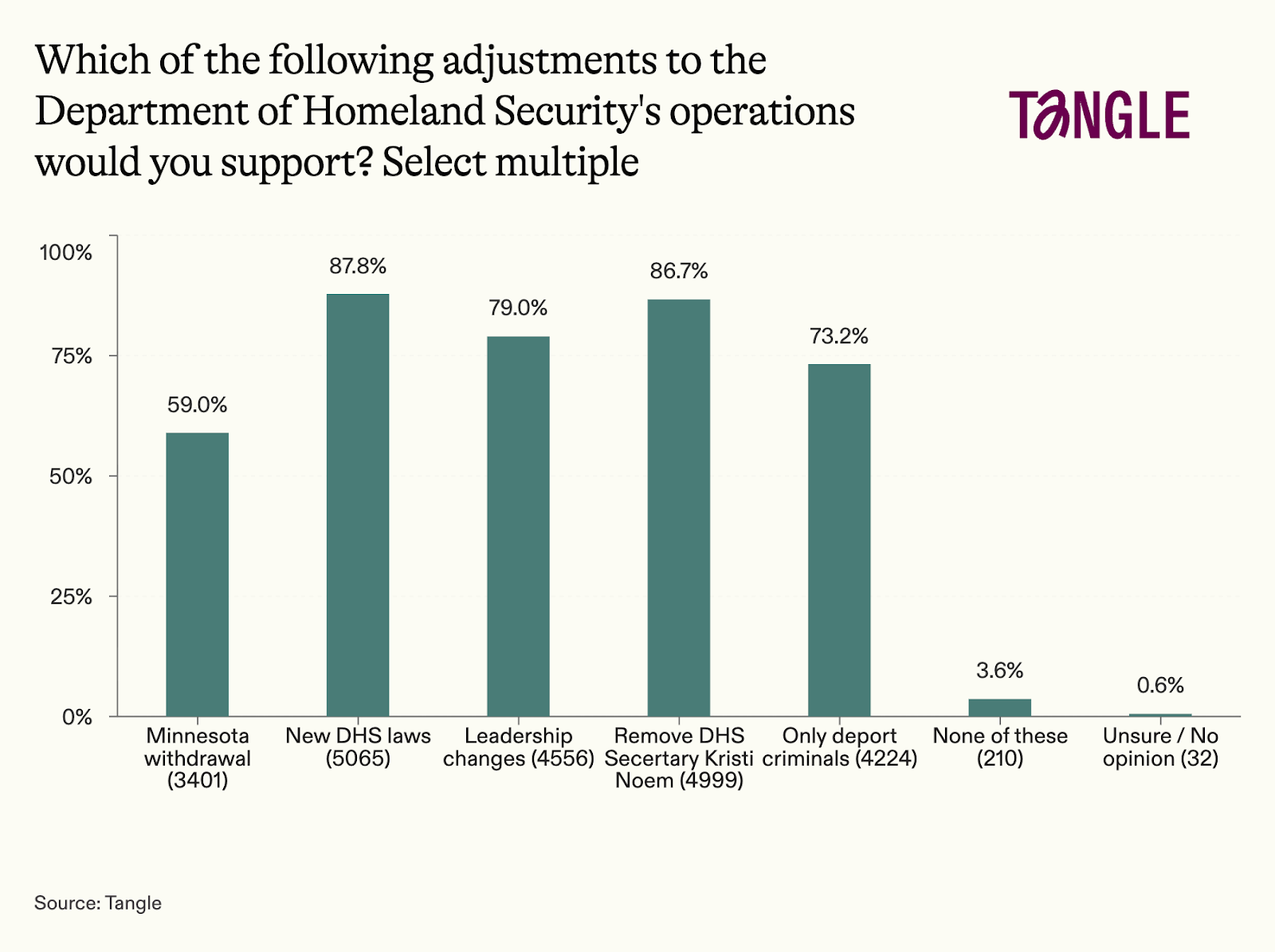
- Thursday’s survey: 5,766 readers responded to our multi-select survey on adjusting the Department of Homeland Security (DHS) with 88% supporting new laws to regulate DHS. “Require judicial warrants for ICE or CBP agents entering private residences,” one respondent said. “Hold ICE shooters accountable. Make the investigations by the FBI public. Have ICE and CBP personnel made aware of punishable consequences of deviance of department’s standards. Keep the American public well informed of these actions,” said another.
Have a nice day.
In 2027, just 54 years after you might have jammed out to Pink Floyd’s Dark Side of the Moon on the radio, astronomers are preparing to land the first U.S. spacecraft on the dark side of the moon. The apparatus, named LuSEE-Night (the Lunar Surface Electromagnetics Experiment–Night), will help astronomers better understand phenomena such as dark matter, dark energy, neutron stars, and gravitational waves. “We don’t even know what the radio sky looks like at these frequencies without the sun in the sky. I think that’s what LuSEE-Night will give us,” Stuart Bale, a UC–Berkeley physicist and NASA’s principal investigator for the project, said. IEEE Spectrum has the story.
Member comments