

I'm Isaac Saul, and this is Tangle: an independent, nonpartisan, subscriber-supported politics newsletter that summarizes the best arguments from across the political spectrum on the news of the day — then “my take.”
Are you new here? Get free emails to your inbox daily. Would you rather listen? You can find our podcast here.
Today’s read: 15 minutes.
Clarification and correction.
We have two notes to make regarding yesterday’s newsletter. First, we wrote that the U.S. suffered 13 casualties so far in the war with Iran. We should have clarified that these were confirmed military fatalities — over 300 personnel have also been wounded (the wounded are often included as part of “casualty” counts in the military).
We also wrote that U.S. F-35s were shot down by friendly fire. In reality, three F-15s were accidentally downed by Kuwaiti air defenses (all crew survived); one F-35 made an emergency landing after passing through Iranian airspace, but it was likely damaged by an Iranian missile. This requires a correction.
We are all officially awake and alert after our spring break.
This is our 153rd correction in Tangle’s 357-week history and our first correction since February 26. We track corrections and place them at the top of the newsletter in an effort to maximize transparency with readers.
And, we’re off…
Our new, moderated, members-only comments section is officially live on the Tangle website. A big shoutout to everyone who participated yesterday — including a few readers who caught today’s correction and clarification. Tangle’s editors noticed an immediate and obvious change in tone of the comments, with much more level-headed disagreement, fewer instances of namecalling, and zero immediate or obvious comments we had to moderate. It’s a great start to what we’re trying to build. Thank you all.
Quick hits.
- BREAKING: The Supreme Court sided with a Colorado counselor’s challenge to a law barring conversion talk therapy in an 8–1 decision, finding that the law regulates speech based on viewpoint and that lower courts did not apply sufficient scrutiny during review. (The ruling)
- President Donald Trump reportedly told aides that he is willing to wind down U.S. military operations in Iran even if the Strait of Hormuz remains impassable for most commercial ships and oil tankers. The president may instead focus on weakening Iran’s navy and depleting its missile stocks. (The report) However, on Monday, President Trump said the U.S. would strike Iran’s energy plants and oil wells if it did not reopen the Strait to commercial traffic. (The threat)
- The Israeli Parliament voted 62–48 to pass a law making the death penalty the default punishment for Palestinians in the West Bank convicted in military courts of carrying out deadly terrorist attacks. Critics say the law will exclusively apply to Palestinians and not Israelis convicted of similar crimes, as the law excludes Israeli citizens or residents, who are never tried in military courts. (The law)
- Spain announced it has closed its airspace to U.S. aircraft involved in the Iran war, with Spanish Defense Minister Margarita Robles calling the conflict “profoundly illegal and profoundly unjust.” Spain previously barred the U.S. from using its military bases for the war. (The closure)
- The national average for a gallon of regular gasoline rose to $4.02, passing $4 per gallon for the first time since 2022. (The prices)
- A human rights organization reported that at least 70 people were killed and 30 others injured in a gang attack in Haiti’s Artibonite region, a significantly higher death toll than initially reported by police. (The attack)
Keep Your SSN Off The Dark Web
Every day, data brokers profit from your sensitive info — phone number, DOB, SSN — selling it to the highest bidder.
What happens then?
Best case: companies target you with ads. Worst case: scammers and identity thieves breach those brokers, leaving your data vulnerable or on the dark web.
It's time you check out Incogni. It scrubs your personal data from the web, confronting the world’s data brokers on your behalf. And unlike other services, Incogni helps remove your sensitive information from all broker types, including those tricky People Search Sites.
Use code TANGLE today to get an exclusive 58% discount on unlimited removals from anywhere that exposes your data.
Today’s topic.
The Department of Homeland Security shutdown. Early Friday morning, the Senate passed a bill that would fund most of the Department of Homeland Security (DHS) for fiscal year 2026, excluding Immigration and Customs Enforcement (ICE) and some parts of Customs and Border Protection (CBP). Later that day, House Speaker Mike Johnson (R-LA) said he would not bring the bill to a vote. The House instead passed a separate bill that would fund DHS in its entirety for eight weeks. Both the House and the Senate have begun a two-week Easter recess, and neither bill is expected to be considered during that time.
Back up: DHS has been partially shut down since February 14 after lawmakers failed to come to terms on a deal to fund the department through September. DHS oversees many different government agencies, including ICE, CBP, U.S. Citizenship and Immigration Services (USCIS), the Transportation Security Administration (TSA), the Federal Emergency Management Agency (FEMA), the U.S. Coast Guard, the Secret Service, and the Cybersecurity and Infrastructure Security Agency (CISA). Unlike most of DHS, ICE and CBP are still largely funded by last year’s One Big Beautiful Bill Act. Many of the agency’s other employees are considered essential and must continue to work during the shutdown without pay.
On Friday, President Trump signed a presidential memorandum directing DHS to reallocate funds to pay TSA employees affected by the agency’s ongoing shutdown. As a result, on Monday, most TSA officers received most of the backpay owed to them, though it is not yet clear if and when additional checks will come.
The TSA staffing shortfall, combined with spring-break travel, produced record-long security lines at airports. Last week, the Trump administration deployed ICE personnel to many of the nation’s busiest airports to try to reduce wait times. During a briefing on Monday, White House Press Secretary Karoline Leavitt said President Donald Trump wants Congress to return to D.C. to finish DHS budget negotiations.
Democrats have called for reforms to ICE and CBP as part of a deal for funding the agencies. Senate Minority Leader Chuck Schumer (D-NY) said that the House-passed bill was “dead on arrival in the Senate.” The Senate deal passed Friday did not include reforms to ICE and CBP. Speaker Mike Johnson (R-LA) said that any DHS funding bill must include funds for ICE and CBP. “We’re not going to split apart two of the most important agencies in the government and leave them hanging like that,” he said. “We just couldn’t do it.”
Below, you’ll read arguments from the left and right about the ongoing shutdown. Then, Senior Editor Will Kaback gives his take.
What the left is saying.
- The left largely blames Republicans for refusing to make a deal to end the shutdown.
- Some criticize Trump’s decision to send ICE to airports.
- Others argue that continuing the shutdown will further erode Congress’s power of the purse.
In Securing America’s Promise, Deborah Fleischaker observed “one DHS funding battle after another.”
“It’s striking that after everything we’ve seen over the past 15 months, Republicans are willing to block funding for DHS rather than constrain immigration enforcement in any way. I worry about how the DHS employees will pay their rent or child care costs, and about the work that may or may not be getting done during this time,” Fleischaker said. “I worked at DHS for almost 14 years, including a year as the acting ICE Chief of Staff, so I understand how important the agency’s mission is, even if I strongly disagree with the Trump Administration’s conception of it. I also experienced firsthand the depth of ICE’s structural, policy, and operational challenges.”
“During previous shutdown fights, Democrats too often fractured under pressure. This time, even without much political leverage or agreement on a vision for immigration, they held firm,” Fleischaker wrote. “Democrats did not suddenly discover a love of immigration fights and they didn’t wake up eager to stake their position on one of the most historically fraught issues in American politics. They held firm because the political ground beneath them had moved. Their constituents had seen something they could not unsee. The risks of inaction or of enabling further excess now outweighs the risks of the political fight.”
In Bloomberg, Erika D. Smith said “[Markwayne] Mullin’s new job at DHS keeps getting harder.”
“A partial government shutdown continues to cripple DHS. Airport security workers aren’t getting paid and the resulting staffing shortages are creating lines so long that waiting travelers now regularly spill out of terminals and into parking lots,” Smith wrote. “In response, Mullin has vowed — as he wrote again on X on Tuesday — that his ‘first priority’ as secretary will be to ‘end the partisan fighting’ and reopen the department. Yet Trump has been largely working at cross purposes, prolonging the shutdown through self-interested ultimatums and self-defeating policy decisions.”
“Democrats are hardly innocent. After all, they caused the shutdown, using it as leverage to force the Trump administration to agree on reforms for immigration enforcement, such as prohibiting ICE and border patrol agents from wearing masks. But the problem for Republicans is that the polling is largely on Democrats’ side,” Smith said. “Which is why Trump’s decision to send immigration agents — and possibly the National Guard — to more than a dozen airports this week seems like such a self-own… Lines at airports are still long and, although the ICE agents are supposed to be doing crowd management, they’ve mostly been seen wandering concourses, fiddling with their phones and standing in line on behalf of travelers who need to use the restroom.”
In Can We Still Govern?, Don Moynihan discussed “Mike Johnson’s institutional betrayal.”
“Remember, ICE and CBP don’t actually need new money. They are funded for multiple years because of the One Big Beautiful Bill Act. Their employees are being paid during the shutdown,” Moynihan said. “So here is where the institutional betrayal comes in. Mike Johnson had a pretty clear choice: A) Reclaim the power of the purse for Congress by passing broadly popular legislation. B) Allow the President not only to dictate appropriations, but also to engage in a potentially illegal scheme to pay TSA employees to deal with public anger. Johnson chose B.”
“We have been here before. During the last major shutdown, Trump claimed that he could decide that members of the military would be paid. There was no major uproar or legal appeal — after all, who is against paying the troops? — but it set a precedent. DHS is sitting on a mountain of money. So Trump could make the same dubious claim that he just needs to move a bit of it around, and the shutdown is over!” Moynihan wrote. “Except, that is not how it works. Either the shutdown — a lapse in appropriations means the executive must lay down its tools — is real, or it’s not. Either the legislative branch determines appropriations, or it doesn’t. The idea that it does is central to our constitutional scheme of government.”
What the right is saying.
- The right blames Democrats for refusing to make a deal.
- Some argue that the public will blame Democrats for the problems they encounter as the shutdown continues.
- Others argue that the shutdown endangers national security.
The Washington Post editorial board described “another government shutdown that won’t end.”
“After the deaths of Renée Good and Alex Pretti, it became clear that President Donald Trump had overreached in his deportation campaign. Democrats had the leverage to ask for some necessary reforms as Americans’ views on federal immigration enforcement agencies soured,” the board said. “Republicans conceded on some helpful oversight measures, like requiring agents to wear body cameras and identification. They also agreed to limiting enforcement in schools and hospitals. But Democrats have refused to budge from their original list of demands.”
“The irony is that while Congress failed to strike a compromise, ICE and the Border Patrol remained funded through the One Big Beautiful Bill Act. Meanwhile, Americans dealt with the fallout of leaving the rest of DHS unfunded,” the board wrote. “Many Democrats are betting that the chaos will work against the party in power, and they can run on fighting to defund ICE. The political logic is sound, but Democrats may come to regret the tactic. It’s not hard to imagine Republicans refusing to fund agencies better aligned with Democratic priorities. Meanwhile, Trump stepped into the governing void with a legally questionable emergency order to fund the TSA. He has turbocharged the trend of concentrating more power in the executive branch, and a feckless Congress only makes it easier.”
In USA Today, Ingrid Jacques wrote “Earth to Dems: your pointless ICE shutdown only hurts you.”
“TSA workers don’t appreciate not getting paid. Hundreds of them have quit, and at least 10% of the workforce aren’t showing up to work. This has led to hours-long lines and missed flights at some of the country’s largest airports — at a time when many families are trying to celebrate their spring break,” Jacques said. “Instead of doing their most basic job — funding the government — lawmakers are playing games and offloading blame to members of the opposing party. Enough already.”
“Perhaps Democrats have forgotten, but it was only a few short months ago that they forced a 43-day government shutdown — the longest on record. And they emerged from it with nothing of note. They didn’t get the concessions they wanted from Republicans on Obamacare subsidies. And public opinion in the end was not in their favor… What makes Democrats think this time will be any different?” Jacques wrote. “While Republicans in both the House and Senate have voted in favor of fully funding DHS, Senate Democrats (with the exception of Pennsylvania Sen. John Fetterman) have stubbornly refused to get on board. And some Democratic support is necessary in that chamber to overcome the 60-vote filibuster threshold.”
In Fox News, Sen. John Kennedy (R-LA) said “Democrats are gambling with our lives by not funding DHS.”
“My Democratic colleagues have opposed President Donald Trump’s agenda at every turn, and that’s their right. But their decision to shut down the Department of Homeland Security (DHS) isn’t some harmless act of political gamesmanship; it’s incredibly dangerous,” Kennedy wrote. “In the one month since Democrats voted to deny funding to DHS, the United States has faced at least four apparent terrorist attacks… These terrorists killed four Americans and injured dozens more. It makes me nauseous to imagine how many more could have died if not for the bravery of local law enforcement officers, the Temple’s armed security and Old Dominion’s ROTC students.”
“At the heart of this meltdown is the fact that many of my Democratic colleagues want open borders. They don’t think we should deport anybody, and they’re holding funding for DHS hostage because they hate the idea that officers at Customs and Border Protection or Immigration and Customs Enforcement (ICE) might actually enforce our immigration laws,” Kennedy said. “In turn, they’ve made a series of demands to resume funding. Some of the requests were reasonable, and the Trump administration agreed to implement them as soon as possible. For example, all ICE officers will wear body cameras during future operations. They’d do it right now, but it’s hard to buy cameras when Democrats won’t approve their funding.”
My take.
Reminder: “My take” is a section where we give ourselves space to share a personal opinion. If you have feedback, criticism or compliments, don't unsubscribe. Write in by replying to this email, or leave a comment.
- The shutdown persists because Congress is weak.
- I worry that this funding fight will only be resolved by further eroding the separation of powers.
- Democrats could take a deal and secure meaningful ICE reforms — but I doubt that will happen.
Senior Editor Will Kaback: The shutdown offers so many points of frustration, I have a hard time knowing where to begin.
This current shutdown is now the longest in U.S. history, surpassing last fall’s 43-day full shutdown. While only affecting one department, that department is an important one, comprising close to 200,000 employees and agencies with diverse, critical missions. Now Congress is in recess and both parties appear far apart on a deal, so the shutdown could plausibly extend beyond two months.
The immediate consequences — hourslong airport security lines, droves of TSA agents calling out sick or outright quitting — are obvious. What worries me most, though, is that the problems that brought us here go deeper than policy differences on immigration enforcement. If it were that simple, both sides probably would have reached a compromise by now. Instead, the situation playing out highlights a constitutional fault line that has grown wider over the course of President Trump’s second term: Congress’s diminishing power of the purse.
The seeds of this shutdown were planted with the passage of the One Big Beautiful Bill Act (OBBBA) in July 2025. Remember: That law was passed via the budget reconciliation process, requiring only a simple majority to clear the Senate. Among its many provisions, the OBBBA gave CBP and ICE billions in new budget authority, allowing the agencies to operate normally even if DHS were shut down. On one hand, this was a savvy political move, anticipating this very moment and preemptively removing any leverage Democrats might have to slow down immigration enforcement. On the other, it’s a total subversion of how appropriations are supposed to work. As Cato’s Dominik Lett wrote in February, CBP and ICE now effectively operate outside of the annual appropriations process, removing Congress’s ability to evaluate their performance and funding levels for several years. It’s a siphoning of the power of the purse by the executive branch, done with Congress’s explicit approval.
The constitutional consequences of this approach to funding extend beyond the current shutdown fight. If the new norm is that the party that controls Congress can use reconciliation to pass years — even decades — of funding for agencies the other party is likely to scrutinize and rein in, the legislative branch effectively cedes its oversight authority. Right now, the fight is over immigration and ICE. Imagine a future Democratic Congress, with a Democratic president, passing a decade of funding for the Environmental Protection Agency, allowing the president to direct the agency to pursue progressive climate change policies without needing to secure funding each year or justify its actions. Our government was designed to give Congress financial authority and avoid unaccountable executive spending, and yet it now seems to be the direction we’re headed.
Republicans and the OBBBA aren’t solely to blame — Democrats, for instance, used the budget reconciliation process to pass stimulus checks and green energy subsidies during the Biden administration — but the move away from standard appropriations is now accelerating. Sen. Ted Cruz (R-TX) recently opened up the playbook for all to see, saying that Republicans should use reconciliation to fund ICE for the next decade. Sen. John Kennedy (R-LA) told Fox News last week that Senate Republicans brought President Trump a version of this plan: a deal to fund TSA and other DHS agencies now, leaving ICE and CBP to be funded through reconciliation. Trump rejected it, and many commentators seized on the moment to blame Trump for the shutdown persisting. But these commentators miss that this outcome would have insulated the agency from Congressional oversight for years to come.
Even more constitutionally troubling is President Trump’s Friday memorandum directing DHS and the Office of Management and Budget to “use funds that have a reasonable and logical nexus to TSA operations” to pay TSA agents. The order only cites 31 U.S.C. 1301(a), which simply reads, “Appropriations shall be applied only to the objects for which the appropriations were made except as otherwise provided by law,” as a legal basis for this move. Beyond this threadbare justification, the source of the funds isn’t specified, either.
I think most Americans want TSA agents to be paid, even if they harbor doubts about the efficacy of the agency. But that’s not what this memorandum is really about. It represents a significant expansion of Trump’s claimed power to use federal funds for purposes that Congress hasn’t approved. If the president — any president — can resolve political problems this way, the legislative branch has lost one of its key checks on executive power. In the words of University of Michigan professor Don Moynihan, “Either the legislative branch determines appropriations, or it doesn’t.” If this move is allowed to stand, we’ll have our answer.
As the constitutional fault line widens, Congressional Republicans have shown little resolve to hold onto their power. Democrats, for their part, have shown little willingness to play ball and reach a deal. The prudence of this strategy is clear: Voter sentiment has turned against ICE and CBP since Renee Good and Alex Pretti were killed in Minneapolis in January, and recent polling suggests voters want substantive changes to immigration enforcement before Congress approves new DHS funding. Democratic lawmakers have also remained united on their list of demands for ICE reform, while President Trump and the GOP have appeared discombobulated, offering varying concessions, pulling back on potential deals, and failing to reconcile differences between chambers. Furthermore, Trump’s attempted gambit — sending about 100 ICE agents to assist with security at airports — seems to have backfired, doing little to alleviate long lines while resurfacing fears of agency overreach.
Why should Democrats compromise? The party’s leaders no doubt remember last fall’s shutdown fight, when their failure to win meaningful concessions on extending healthcare subsidies produced significant blowback from their base. Right now, with Trump waging an unpopular war in Iran, Republicans racking up losses in special elections and polls showing Democrats in a strong position ahead of the midterms, the case for making concessions is virtually nonexistent.
But the erosion of the separation of powers degrades the very foundation Democrats are using for their leverage. Republicans are never going to agree to all of their demands, so short of ceding on some reforms, the next best option appears to be funding non-ICE/CBP agencies. The bill that passed the Senate early Friday morning would have done just that. Kicking the ICE and CBP can down the road only heightens the prospect that it will eventually be resolved by reconciliation, with Democrats getting none of their reforms. Ironically, the only thing blocking this path is President Trump’s opposition to the Senate deal, but that could change at any time. All the while, ICE and CBP continue to operate unimpeded.
Instead of digging in, Democrats should take a deal. Of the 10 demands they released in February, at least four seem achievable in the immediate term: requiring a judicial warrant to enter private property, mandating body cameras, verifying non-citizenship before detention, and allowing states to investigate potential crimes committed by DHS agents. Banning agents from wearing face masks will remain a sticking point, but I don’t think this one reform is worth holding out over when others are within reach.
My preferred outcome would be to fund all of DHS through an appropriations bill, but I know that is also unlikely at this juncture. Not only do Democrats seem willing to let the shutdown persist, but that kind of deal is not guaranteed to pass both chambers (or overcome a veto). And as bad as some of the airport security delays have been, I don’t think lawmakers are truly feeling the heat yet. President Trump’s TSA payment maneuver, while legally dubious, is already leading to airports returning to normal. As the shocking videos of TSA lines stretching out the door fade from our social media timelines, so too will the public’s urgency.
I don’t see any end in sight, and that leaves me feeling deeply cynical. In an ideal world, Congress could strike a deal and send a message that its members can still compromise to resolve their differences — and that it intends to hold onto its delegated powers. But we simply don’t live in that world. Instead, we’re on a path to put more power in the hands of the executive. I don’t know where that path leads, but I don’t want to follow it.
Take the survey: How do you think DHS should be funded? Let us know.
Disagree? That's okay. Our opinion is just one of many. Write in and let us know why, and we'll consider publishing your feedback.
Your questions, answered.
Q: If the vice president were to break ranks with the president in such a way that the president wanted to “fire” him, can he do that?
— Chris from New Orleans, LA
Tangle: The short answer is no — the president cannot fire anybody elected to their office, and the vice president is an elected official. Like the president, the vice president can only be removed from office through impeachment.
This is, admittedly, a little confusing, since the vice president is part of the president’s cabinet and the president can freely dismiss other cabinet members at will, meaning the vice president is a bit of an anomaly in the executive branch. The office was not always defined quite as well as it is today — and the Constitution did not initially provide the ground rules for the office that we have now. Our nation’s first vice president, John Adams, considered himself to be more “the head of the legislative” than a part of the president’s cabinet (which was also not yet defined). In fact, from Adams’s election until 1804, the vice president was the person who received the second-most votes in the presidential election. With the ratification of the 12th Amendment that year, the vice presidency started to have its own dedicated candidates, allowing parties to run the unified tickets we see today.
One thing that hasn’t changed since Adams’s time is that the vice president retains some independence from presidential oversight. Politically, the vice president’s office doesn’t have much authority outside what the president confers onto the office; but constitutionally, the president doesn’t have direct control over the vice president.
Want to have a question answered in the newsletter? You can reply to this email (it goes straight to our inbox) or fill out this form.
Your SSN Is Already Being Sold — You Just Don't Know to Whom
Data brokers profit daily from your phone number, birthdate, and Social Security number.
Best case: more targeted ads.
Worst case: breaches that land your info on the dark web. Incogni removes your data from all broker types — including People Search Sites — automatically.
A deeper look.

U.S. Attorney General Benjamin Civiletti | Rob Croes via Wikimedia Commons
Though they seem like business as usual today, government shutdowns didn’t always actually “shut down” the agencies experiencing a funding lapse. Prior to the early 1980s, agencies would often continue to operate even if they had no appropriated funds. That changed when U.S. Attorney General Benjamin Civiletti succeeded in his push for a stricter interpretation of the Antideficiency Act, requiring agencies to halt day-to-day operations and furlough many employees during a lapse in Congressional funding.
The extras.
- One year ago today we covered the Signal chat controversy.
- The most clicked link in our last newsletter was the ad in our free version for the Dignity Index.
- Nothing to do with politics: How long Americans will work in the same job, over time.
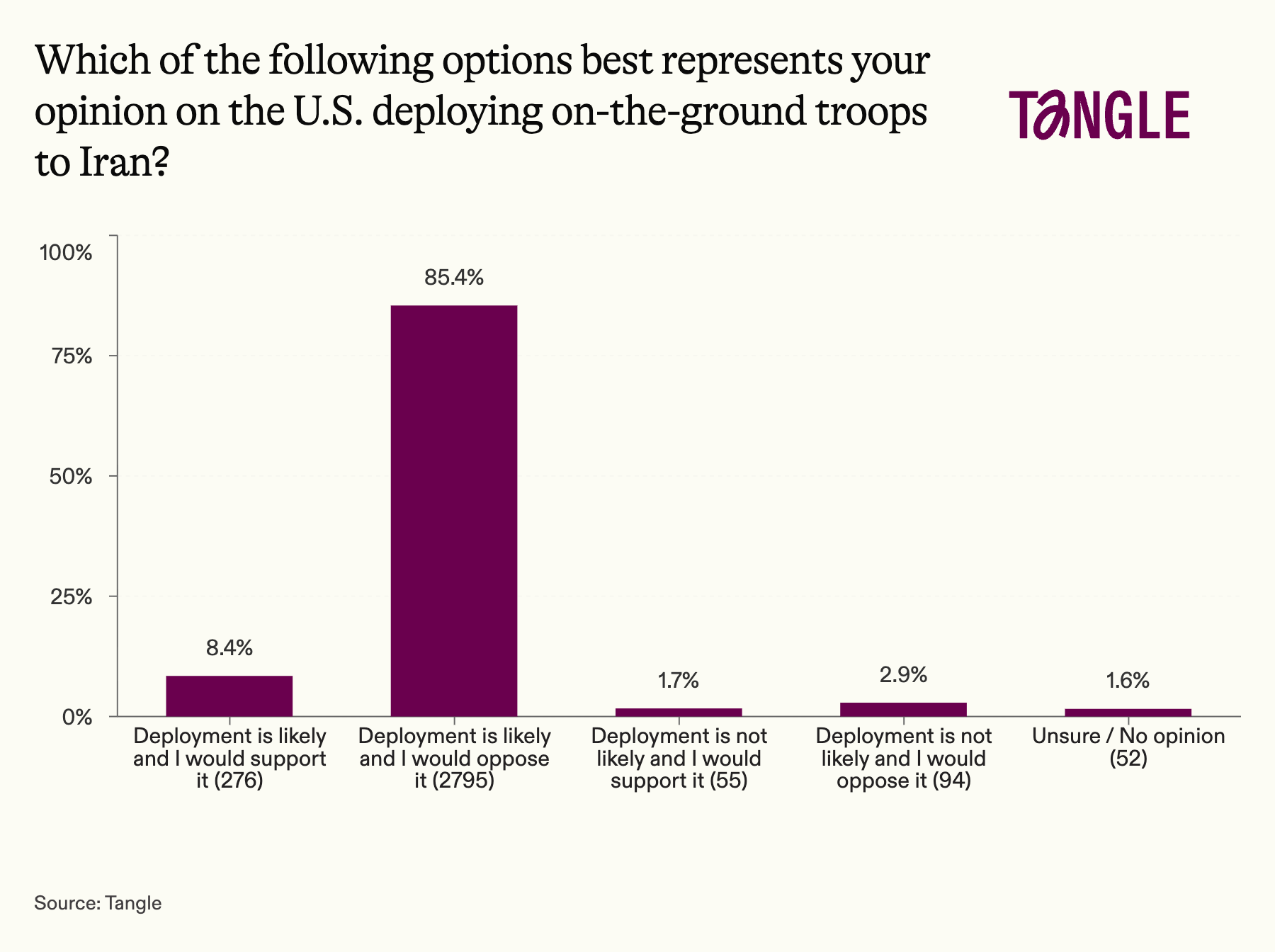
- Our most recent survey: 3,272 readers responded to our survey on the U.S. deploying ground troops to Iran with 85% opposing deployment but considering it likely. “Having started the war, Trump needs to finish it in a way that puts an end to the issues he is supposedly trying to address,” one respondent said. “Invading a nation is never quick and easy. Putin thought he could take Ukraine quickly. Iran is at least as determined as Ukraine,” said another.
Have a nice day.
Of more than 40 million entries across all the major contests for the annual NCAA March Madness tournaments, one perfect bracket remained last Monday: a women’s bracket belonging to 14-year-old Otto Schellhammer, a Pittsburgh eighth grader with no previous basketball knowledge. Although Notre Dame’s victory over Vanderbilt on Friday means Otto’s bracket won’t be perfect, he still retains his last-perfect-bracket status. “I think it’s absolutely hilarious,” Amy Schellhammer, Otto’s mom, said. “It’s just so fun to see… He’s been watching and it’s making him more excited about it.” The Associated Press has the story (and you can view Otto’s bracket here).

Member comments