

I'm Isaac Saul, and this is Tangle: an independent, nonpartisan, subscriber-supported politics newsletter that summarizes the best arguments from across the political spectrum on the news of the day — then “my take.”
Are you new here? Get free emails to your inbox daily. Would you rather listen? You can find our podcast here.
Today’s read: 13 minutes.
Meet the Tiny Hearing Device That Outsmarts the Noise
What happens when you combine German engineering with the world’s most trusted name in hearing care? The biggest breakthrough in hearing technology in more than a decade. Introducing the Horizon IX hearing aid, the world’s first dual-processing hearing aid, which separates speech and background noise to deliver never-before-heard clarity. They also come with:
Bluetooth and smartphone -connectivity
Full rechargeability
Award-winning customer service
Insurance coverage and flexible finance options
Join 540,000+ people hearing better than ever. Find out if you qualify for a 45-day no-risk trial and hear the difference!
What gives me some hope.
From the Charlotte stabbing to the assassination of Charlie Kirk, last week’s slate of news was full of heaviness and violence. So we tried to put some positivity out into the world: On Friday, Tangle founder Isaac Saul published a piece about how his first eight months of fatherhood have restored some of his faith in humanity, and also made him realize that America isn’t nearly as anti-kid as many people say.
The piece, titled “My son gives me hope,” is fully accessible for Tangle members. You can read a free preview of the article and subscribe to unlock the full thing.
Quick hits.
- Authorities arrested two suspects believed to have been responsible for placing an incendiary device under a news media vehicle in Salt Lake City, Utah, on Friday. The device was lit but did not function as intended, and no one was injured. (The arrests)
- President Donald Trump announced that he plans to deploy the National Guard to Memphis, Tennessee, to address crime in the city. (The announcement)
- The Environmental Protection Agency said it will end the Greenhouse Gas Reporting Program, which had tracked the quantity of greenhouse gases released by industrial facilities. (The termination)
- Nepalese President Ram Chandra Poudel appointed former Supreme Court Chief Justice Sushila Karki as interim prime minister following days of large protests that forced the resignation of the former prime minister. Poudel also set March 5 as the date for new legislative elections. (The appointment)
- Romania detected a Russian drone in its airspace on Saturday but opted not to shoot it down. The European Union’s foreign policy chief called the incursion a “reckless escalation.” (The incursion) Separately, President Trump said he was prepared to levy new sanctions on Russia if North Atlantic Treaty Organization countries agreed to do the same. (The comments)
Today’s topic.
The investigation into Charlie Kirk’s assassination. On Friday, authorities said they had arrested a man suspected of killing Charlie Kirk, the conservative commentator and activist who was shot during an event at Utah Valley University on Wednesday. Over the weekend, state and federal officials released new information about the suspected shooter that points to several potential motivations behind the attack. Meanwhile, Kirk’s death has prompted a range of responses from both sides of the political spectrum, including debates over his legacy and the reactions to his assassination.
Note: Due to the well documented contagion effect, Tangle’s policy is to not name shooters or suspects in high-profile attacks.
According to Utah Gov. Spencer Cox (R), law enforcement identified the suspect after his family told a retired law-enforcement official and family friend information that indicated he had committed the shooting; the friend relayed that information to local police. The suspect’s family said that he had become “more political” in recent years and had explicitly shared his dislike of Kirk. He was subsequently taken into custody on suspicion of aggravated murder, felony discharge of a firearm, and obstruction of justice; in Utah, an aggravated murder conviction carries the possibility of the death penalty.
An affidavit filed on Friday stated that investigators recovered bullet casings with the suspected murder weapon inscribed with potentially political messages, including one that read, “hey fascist! CATCH!” and another that referenced an Italian anti-fascist song. The messages have also been used ironically by internet gamers; the suspect’s intended meaning is unclear. Authorities also reviewed messages on the communications platform Discord that allegedly linked the suspect to the shooting. On Monday morning, FBI Director Kash Patel announced they found the suspect’s DNA at the scene and were aware of a note from the suspect declaring his intention to kill Kirk.
Investigators are reportedly examining the relationship between the suspect and his roommate, who is transgender, as they seek to determine a motive for the shooting. The roommate has cooperated with authorities, sharing messages that appear to show the suspect discussing the location of the murder weapon. One official described the suspect’s roommate as a “person of interest” in the investigation; federal and state officials are also exploring whether left-wing groups in Utah might have links to the suspect and could have been aware of plans to target Kirk ahead of time.
Amid the investigation, Kirk’s family, friends, and colleagues have eulogized him. On Friday, Kirk’s wife Erika delivered a tribute to him, saying, “The movement my husband built will not die,” adding that the “evil-doers” responsible for his death “have no idea what you just have unleashed across this entire country.” Separately, on Sunday, prominent members of the Trump administration and Congress attended a vigil in Kirk’s honor in Washington, D.C.
Some Democrats and commentators on the left have expressed alarm at the right’s response to Kirk’s assassination, suggesting that it could be used as a pretext for crackdowns on free speech. Defense Secretary Pete Hegseth has reportedly directed his staff to identify members of the U.S. military who have mocked or endorsed Kirk’s killing online, while conservative influencers have launched campaigns to seek disciplinary measures for others who engage in similar behavior.
Today, we’ll share views from the left and right on the response to Kirk’s assassination and suspected shooter, followed by my take.
What the left is saying.
- Many on the left say the suspect’s identity doesn’t align with the right’s assumptions.
- Some argue the right’s response to Kirk’s death has worsened the situation.
- Others explore the relationship between the suspect and internet culture.
In USA Today, Rex Huppke said “Charlie Kirk shooting suspect doesn’t fit MAGA’s reckless political narrative.”
“In the days since Charlie Kirk’s tragic shooting death, Republican lawmakers, influencers and President Donald Trump have been wildly and irresponsibly predicting and posting online, with great certainty, that the shooter must be a radical leftist,” Huppke wrote. “Predictably, the grotesque prejudgment has fallen flat, and the actual suspect in no way fits the right’s cynical political narrative… Shell casings recovered by authorities were engraved with references to internet memes and online gaming. [The suspect] shows up in a family Halloween photo in a Trump-related costume. Neighbors said he grew up in a church-going Mormon family.”
“Narrative chasing is absolutely a bipartisan problem. There were liberals, myself included, who pondered if the shooter might be a MAGA loyalist seeking to create a Reichstag fire-like situation that would allow Trump to blame the left and take more authoritarian control of the country under the guise of ‘safety,’” Huppke said. “The MAGA narrative machine regarding Kirk’s killing, on the other hand, blew past facts faster than I’ve ever seen in a high-profile shooting. There was no suspect and quite literally zero evidence of a motive, and the right — from the president on down — leaned fully into howls about liberals.”
In Vox, Eric Levitz criticized “the right’s vicious, ironic response to Charlie Kirk’s death.”
“For almost all of our species’ history, to hear a person speak on a near-daily basis was to know them intimately. Countless Republicans, therefore, experienced Kirk’s death as though it were the loss of a friend. For liberals, meanwhile, Kirk’s killing constituted an appalling assault on political liberty,” Levitz wrote. “Kirk’s assassination was thus an assault on the democratic project — on our capacity to collectively govern ourselves through the exercise of reason. It was also alarming, obscene, and ironic in the grimmest possible sense. The right’s response proved to be much the same.
“Within hours of Kirk’s shooting, the most powerful Republicans in the country — from the president to Fox News hosts to megabillionaires — were agitating for authoritarian repression, and justifying it with incendiary lies,” Levitz said. “A conservative movement committed to Charlie Kirk’s ostensible ideals — to free speech and open discourse — would respond to his assassination by decrying political violence in all its forms and rejecting the pernicious notion that the government must suppress certain ideas to keep the public safe. But such a movement does not exist.”
In The New York Times, Nathan Taylor Pemberton wrote about “Charlie Kirk’s killing and our poisonous internet.”
“The only thing that can be said conclusively about [the suspect], at this moment, is that he was a chronically online, white American male. The internet’s political communities and the open-source sleuths currently scrambling to place [him] into a coherent ideological camp certainly won’t be content with any of this. Nor will they be satisfied with the other likelihood awaiting us: that [the suspect], the son of a seemingly content Mormon family, probably possesses a mishmash of ideological stances,” Pemberton said. “They also will not be satisfied that this horrific, society-changing act of violence was most likely committed both as an ironic gesture and as a pure political statement.”
“The combative and rage-bait style that Mr. Kirk pioneered has become the dominant mode for the right. And it’s probably more accurate to say this is how many young Americans as a whole exist on the internet today, trolling and provoking anyone who crosses their paths,” Pemberton wrote. “That his killer might have been in pursuit of a similar moment of viral conflict is a grim encapsulation of the nightmare cesspit we’ve entered.”
What the right is saying.
- The right says the suspect appears to have been radicalized by extreme anti-conservative rhetoric on the left.
- Some accuse the left of a double standard when discussing political violence against conservatives.
- Others push back on efforts to punish people who criticize Kirk in response to his death.
In The New York Post, Michael Goodwin wrote “Charlie Kirk’s assassination is the result of a decade of anti-Trump rhetoric from the left.”
“The accused killer of Kirk… was ‘deeply indoctrinated with leftist ideology,’ according to Utah Gov. Spencer Cox,” Goodwin said. The suspect “seems to have gotten drunk on the social media Kool-Aid about the evils of Trump, Kirk and everyone who subscribes to any conservative principles. The penchant for calling Trump the devil incarnate has put a target on his back and given would-be assassins a license to kill him and others in his circle…. Charlie Kirk is a victim of that sickening campaign. Only an evil sect could see such a kind, religious man and doting father as a worthy target for slaughter.
“The celebrations and approval online and elsewhere for the soul-shattering murder are the equivalent of sewage coming to the surface. Supposedly reputable people, including medical and education professionals, along with some government officials, are giving their assent to public butchery because of policy disagreements. Such bile is defensible only if you believe murder is politics by another name,” Goodwin wrote. “It is also alarming that the alleged actions of [the suspect] bear a terrifying similarity to those of [the man] who tried and nearly succeeded in killing Trump during a campaign rally in Butler, Pa., last year.”
In The Daily Signal, Erick Erickson called the response to Kirk’s death “a turning point.”
“Over the past number of years, there have been more and more acts of violence in politics. MSNBC operates as an assassination fan fiction network. As an assassin fired at President Donald Trump in Butler, Pennsylvania, the conversation on MSNBC, while the bullet was in the air, was on the need to stop Trump, who would otherwise be an authoritarian threatening our democracy,” Erickson wrote. “The day before Kirk’s assassination, Connecticut Sen. Chris Murphy told Chuck Todd, ‘Our only chance to save our democracy is to fight fire with fire right now’... Someone took up arms for that supposed war and fought Charlie Kirk’s words with bullets.”
“When Trump says things that the Left believes are violent, they demand that others denounce him. Any act of violence by anyone on the right is tied to Trump and rightwing sentiment. But time and time again, when someone on the Left acts out violently, the progressive American press, Democrats, the cultural elite, and Hollywood always find an excuse to say it was not them,” Erickson said. “The Left and Democrat leaders need to acknowledge that Democrat politicians and MSNBC hosts have been prodding progressives towards violence.”
In Fox News, Jonathan Turley said “Charlie Kirk wouldn't fire people who hated him, he'd win them over.”
“Some on the right are calling for people who denounce Kirk or celebrate his death to be fired. That ranges from professors to public employees… The way to honor Charlie Kirk's life and legacy is not with hypocrisy and intolerance. That is what he died fighting against,” Turley wrote. “Kirk wanted unfettered debate. He wanted people to be able to express themselves regardless of how the majority felt about their views. He was the victim, not the advocate, of cancel campaigns.”
“There are instances where hateful views may raise grounds for termination… those who use their official, academic or corporate positions to espouse hateful messages risk termination,” Turley said. “However, many of these people were speaking as individuals outside of their positions, and their hateful commentary is not necessarily compromising or conflicting with their positions… We cannot become those we have long fought against in the free speech community. More importantly, we cannot become those whom Charlie fought against up to the very moment of his murder.”
My take.
Reminder: “My take” is a section where I give myself space to share my own personal opinion. If you have feedback, criticism or compliments, don't unsubscribe. Write in by replying to this email, or leave a comment.
- We still don’t know much about Kirk’s alleged shooter.
- One thing I do know is that the rush to blame entire ideologies for this event is making things worse.
- The imminent threat, if there is one, is that far too many elected Republicans are responding to this by demanding a crackdown on the left.
First and foremost, I want to acknowledge that our coverage of Kirk’s killing has drawn a tremendous amount of feedback and criticism. We are planning to publish a members-only reader feedback edition this Friday, and I have already responded to some of that feedback in our Reddit community. I also want to acknowledge so many of you who heard me get emotional on the Tangle podcast and then reached out online to share your support; it’s been a long few weeks (months? years?) of distressing news in this country.
Today, I’m going to try to focus mostly on the immediate questions at hand. The day after Kirk was killed, I wrote about one fundamental presumption I was making:
“I know it’s not wise to make presumptions about motive before we have a suspect in custody. For now, though, I am going to make a presumption — one I feel confident in — that in this era of political violence, someone killed Kirk for his political rhetoric.”
All indications still point to this being the case. I still don’t have a clear picture of the shooter in question, but Utah Gov. Spencer Cox says the suspect was radicalized by leftist ideology and had a romantic relationship with his trans roommate. That claim remains unsubstantiated by publicly available evidence, but Cox tends to be someone who tries to reach across the aisle and avoid bombastic claims. So, if Cox is pushing that claim publicly without rock solid evidence, I’d be shocked — and appalled. Right now, we just don’t know that much information.
Meanwhile, a number of internet sleuths have tried to pin the shooter as a far-right “groyper,” a member of a group of alt-right, white-nationalist extremists most notoriously associated with the proud racist and antisemite Nick Fuentes. Fuentes hated and criticized Kirk for supporting Israel and for inviting too many people into the conservative movement (i.e. racial minorities and Jews), so this theory is at least plausible.
However, the internet sleuths pushing this potential motive have pretty thin evidence — mostly a Halloween costume, the ironic online usages of the messages on the bullets, and rumors of Discord posts that are now inaccessible because the shooter’s account has been suspended. There is a compelling theory that the shooter was motivated by a kind of nihilistic, anti-social worldview that is increasingly common among young men in our country — one that is in many ways apolitical, or at least appealing across political lines. Certainly, there are a lot of lonely, angry, hopeless kids out there who view other people’s lives more like they’re characters in a video game than fully human.
What seems most likely to me is that Kirk’s assassin was a very online male with access to guns and some really, really extreme politics. This has been the case with other recent political shooters — in Washington, Pittsburgh, and elsewhere. It is a story we have seen over and over and over. And it is going to keep happening unless we actually do something different — not just by addressing gun access or mental health or extremist politics, but through all of the above. Still, I cannot emphasize enough that we are still learning a lot about the shooter, and many of the initial reports about him have been proven wrong.
What’s taking place in the broader political realm in the wake of Kirk’s shooting is pretty alarming, too. On the left, there were some genuinely grotesque reactions to Kirk’s death, and in my opinion, far too many. But these reactions are still the vast minority. The number of people who support or excuse political violence is still vanishingly rare when compared against every person posting on the internet — even if your algorithm is telling you otherwise. I am unaware of a single elected Democrat doing anything other than clearly and unambiguously decrying Kirk’s murder; this is true of most prominent liberal influencers, too. There are exceptions, but again, they are rare.
Unfortunately, on the right, many influencers and audiences are being spoon-fed a diet of these exceptions and told that this is the world the left wants, where people like Kirk are murdered for their political views. Most importantly, President Trump blamed Kirk’s killing on the “radical left,” falsely framed all political violence as the product of radical leftism, and promised to crack down on anyone who “contributed” to the murder — and to shut down organizations that fund or support it. This is a wide net to cast that telegraphs the president’s intention to coalesce more power and suppress more speech, which his administration has already been doing plenty of.
Rather than turn the temperature down, I’ve seen dozens of other elected Republicans and prominent right-wing influencers raising it, by doing everything from declaring civil war to calling for an all-out assault on anything vaguely “left” or “liberal” to locking up or silencing critics of the right. President Trump seemingly endorsed a piece of Cold War legislation that could be used to censor and punish media organizations. Random Americans across the country are already losing their jobs or being targeted for not being sufficiently deferential toward Kirk’s legacy (meanwhile, a prominent Fox News host is holding onto his job after suggesting on live television that homeless people should be killed via lethal injection). Some of those firings may have been justified, but I fear there is a full-on assault coming against the left, and not the rhetorical kind — instead, it seems to be aimed at fundamentally destroying liberal organizations and suppressing speech from liberals, all in Kirk’s name.
This, today, is the immediate threat. And it is a sick and twisted irony that this threat follows the killing of Charlie Kirk. Again: Kirk was quite clear that he was doing what he was doing in an effort to prevent civil war and political violence. Yes, at his worst he excused and subtly endorsed forms of political violence, but he never engaged in or incited it himself. While conservatives are trying to make the entire left responsible for this shooter’s actions, Kirk was the one who said “WORDS ARE NOT VIOLENCE. ONLY VIOLENCE IS VIOLENCE.”
We cannot criminalize or suppress speech in an effort to solve political violence — we actually need to do the opposite. We need to endorse and promote speech, even if it is uncomfortable or confrontational, and we must ensure more Americans who hate each other’s politics can actually get to know each other and find ways to connect on a human level in real life.
I want to be clear that plenty of good actors are out there, too. GOP Sen. James Lankford (OK) appeared on “Face the Nation” with his Democratic colleague Chris Coons (DE) to urge people to step back from the brink. House Speaker Mike Johnson (R-LA) rightly said we “have got to stop framing simple policy disagreements in terms of existential threats to our democracy.” While Trump was promising vengeance, Utah’s Republican governor was demanding an off-ramp, insisting people “log off, turn off, touch grass, hug a family member.” I genuinely appreciate and commend this kind of response, but I fear it's being drowned out by all the others.
For now, the truth about Kirk’s shooter is still unclear — and probably will be for some time. What is obvious, and immediate, is that our political leaders can either continue demonizing the other side as an existential threat or start trying to build genuine political bridges to turn the temperature down. I was glad to see so many of Kirk’s harshest critics respond to his death in a similar way as I did. This is a moment, in my view, for us to lean into our humanity and dig deep for some empathy; that requires not just practicing this stuff ourselves, but also criticizing any politicians, influencers, or peers who are inflaming tensions rather than addressing them. The current president is first in line, and so far he’s off to a bad start. All that means is that the challenge is greater for the rest of us.
Take the survey: What do you think motivated Charlie Kirk’s shooter? Let us know.
Disagree? That's okay. My opinion is just one of many. Write in and let us know why, and we'll consider publishing your feedback.
Your questions, answered.
Q: In response to Isaac’s critical issues to solve:
How is affordable housing more solvable? Fixing rent or home prices would probably result in people unwilling to invest in rental or home properties… and government subsidizing rent or housing has always been a disaster. How would you propose solving it?
— Jerome from Schaumburg, IL
Tangle: To be fair to Isaac, in response to a reader question two weeks ago, he wrote that creating affordable housing is “more solvable in the near term” than healthcare. Housing certainly is an intractable issue, but most people would probably agree that it’s not as intractable as health care, which may be the single most pervasive large-scale problem the government is facing.
But still, it’s probably not productive to quibble over which incredibly difficult issue is harder to solve; you’re right, price-fixing has failed before, and even well intended proposals like “inclusionary zoning” can often lead developers to decide not to build new homes, which then makes the problem worse.
Among our staff, we have a few different ideas for how to help fix the housing availability crisis, involving a range of solutions on the spectrum of less government involvement to more. Here are two such ideas on either end of that spectrum:
Reduce zoning requirements: All over the country, local ordinances restrict what kinds of homes builders can develop. Removing zoning requirements can allow for more high-density housing, which would increase supply, lower costs and offer an attractive return on investment to developers, leading to more construction and even lower housing costs. This is similar to the “abundance” approach.
Increase taxes on second homes: Providing a disincentive to wealthier land owners against owning multiple properties would also serve to create more supply by making existing homes and apartments available to others. Secondarily, revenue from these taxes can fund public services — like schools, police, and public transit — that can raise standards of living for those in affordable housing units.
Want to have a question answered in the newsletter? You can reply to this email (it goes straight to our inbox) or fill out this form.
Under the radar.
On Tuesday, results from the National Assessment of Education Progress (NAEP) showed that U.S. high schoolers continue to struggle on math and reading exams, adding to declines that began during the Covid-19 pandemic. 12th graders’ scores dropped to their lowest level in more than 20 years, with 67% scoring at least “basic” on the reading test and 55% achieving the same level on the math test. While the recent declines began during the pandemic, educators say school closures and rising absenteeism are also contributing to the issue. “These results should galvanize all of us to take concerted and focused action to accelerate student learning,” Matthew Soldner, the acting commissioner of the National Center for Education Statistics, said. The Associated Press has the story.
Numbers.
- 33. The approximate length, in hours, of the manhunt for the suspect in Charlie Kirk’s shooting before authorities arrested a suspect on Friday.
- 1. The number of semesters the suspect was enrolled in college (at Utah State University in 2021).
- 7,000. The number of leads the Federal Bureau of Investigation (FBI) fielded before arresting the suspect.
- 11,000. The number of leads the FBI had received by the time they announced the suspect’s arrest.
- 3. The number of unspent bullets in the magazine of the alleged murder weapon.
- 71% and 29%. The percentage of U.S. adults who said they expected and did not expect, respectively, more civil violence in the United States in the year following the attempted assassination of President Donald Trump, according to a July 2024 More in Common/YouGov poll.
The extras.
- One year ago today we had just published a Friday edition on how to read election polls.
- The most clicked link in Thursday’s newsletter was the fired MSNBC analyst.
- Nothing to do with politics: A German doorbell prankster turned out to be a slug.
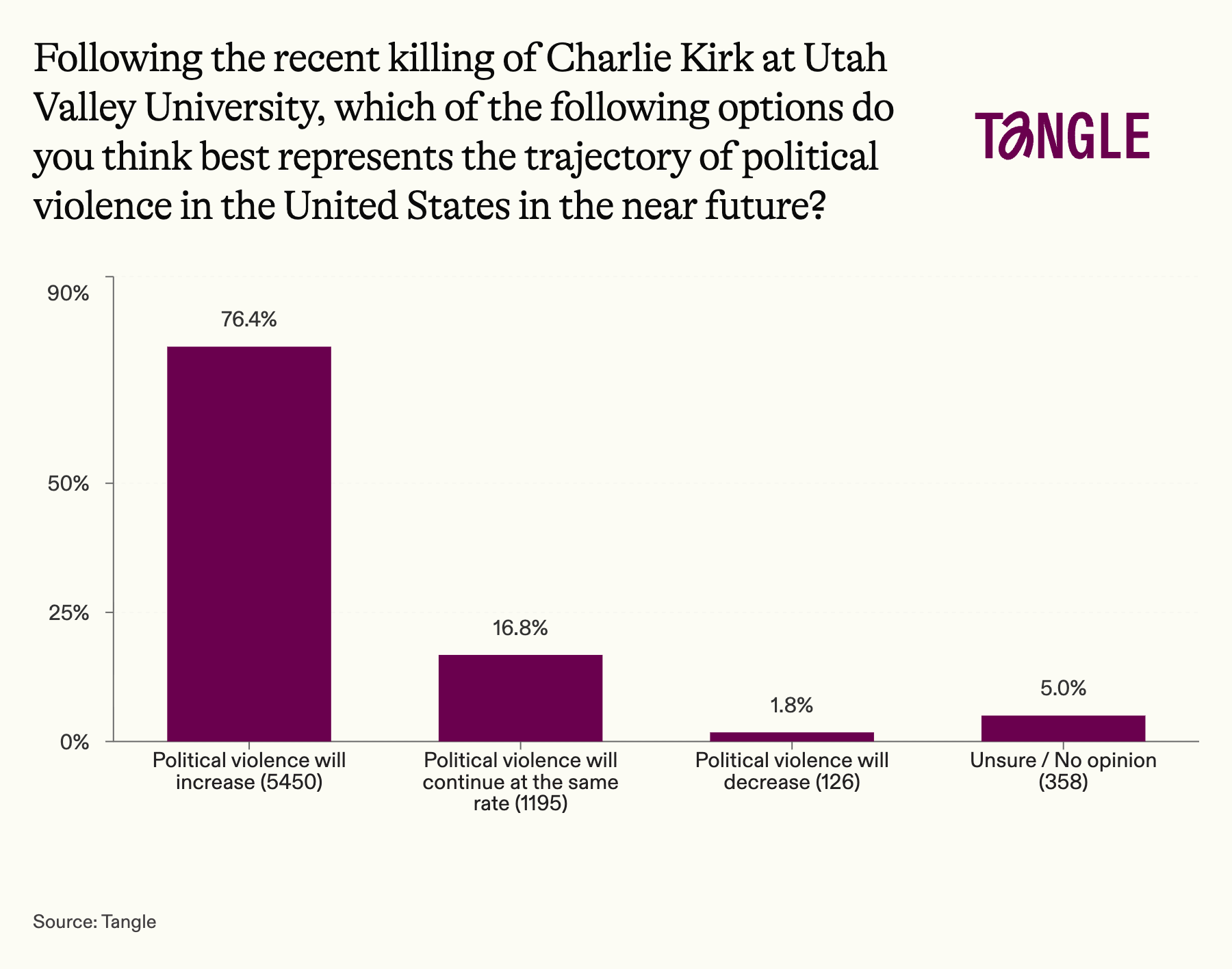
- Thursday’s survey: 7,129 readers responded to our survey on political violence with 77% saying they believe it will increase after Charlie Kirk’s assassination. “I am scared that it will become like school shootings -- horrible at the moment and for a few days after, but occurring again and again,” one respondent said.
Have a nice day.
Nearly half of all renters in Madison, Wisconsin, spend more than 30% of their income on housing, and the city faces one of the lowest rental vacancy rates in the country. In response to this critical shortage, the congregation at St. John’s Lutheran Church in downtown Madison has decided to transform its current worship space to include temporary shelters. The new complex will include a sanctuary, community events space, and 110 income-capped housing units, according to Reverend Peter Beeson. “We really came together and realized… that we could use our land and our building for good and flourishing of our community,” Beeson said. Wisconsin Public Radio has the story.

Member comments