In the early days of 2023, a group of researchers and activists published a report with a shocking conclusion: Utah’s Great Salt Lake was losing water so fast that it was on track to effectively disappear within five years.
The paper instantly made national news, with headlines warning of catastrophic consequences:
CNN: “Great Salt Lake will disappear in 5 years without massive ‘emergency rescue,’ scientists say.”
Smithsonian Magazine: “Drying Great Salt Lake could expose millions to toxic arsenic-laced dust.”
The Guardian: “‘Last nail in the coffin’: Utah’s Great Salt Lake on verge of collapse.”
The Guardian, again: “Great Salt Lake’s retreat poses a major fear: poisonous dust clouds.”
NPR: “Climate change and a population boom could dry up the Great Salt Lake in 5 years.”
WBUR: “Collapse of Utah’s Great Salt Lake is ‘so close you can feel it.’”
The task facing lawmakers, scientists, and the public was daunting: No community in the world has ever reversed a saline lake in decline, and many of these lakes are starting to disappear. But failure to act — as the report and the ensuing news articles warned — would mean near-certain devastation to the local environment, economy, and residents’ quality of life. The lake provides an estimated 7,000 jobs in Utah and supports several key industries, such as salt production, lithium batteries, brine shrimp, and even alpine skiing (from lake-effect snow). All in all, it contributes about $1.9 billion to Utah’s economy annually.
The lake is similarly critical to the ecosystem of the region — and the world: Approximately ten million birds from 338 different species across the planet visit the lake during their migrations, and it supports 80% of Utah’s valuable wetlands.
Unsurprisingly, then, the report prompted immediate, bipartisan action; at the start of the Utah Legislature’s annual session in January 2023, lawmakers proposed 14 bills supporting water conservation and investing in revitalizing the lake. They passed nine and created the Office of the Great Salt Lake Commissioner, tasked with developing a strategic plan for the lake. In short order, a litany of public and private interests snapped to attention and got to work, seemingly catalyzed by the report’s warning that the lake could be gone by the end of the decade.
Today, over two-and-a-half years since scientists issued the five-year warning, state leaders have begun questioning the credibility of the report, and that initial momentum has flagged. Most notably, in March 2024, Utah Gov. Spencer Cox (R) called the prediction “laughable,” telling NPR, “It's a joke and everybody knows it's a joke. They were never serious about that. That's the ‘doomerism’ that is terrible for people.”
Since the report was issued, the Great Salt Lake’s water loss not only slowed, but its water level actually increased. In June 2024, the lake’s two sides — which are divided by an embankment — were three feet higher than they had been two years prior.
So what happened here? At first blush, the story appears to be an example of science gone wrong — an exaggerated claim of imminent danger, founded on flawed assumptions and questionable processes, that damaged the public’s trust in the scientific community and its receptiveness to future warnings. But could it actually be a story of the power of concerted action, or poor science communication in the media?
Drawing on interviews with the lead authors on the 2023 “five-year” report, Utah’s Great Salt Lake commissioner, a former member of Utah's Air Quality Board and an expert on the lake’s atmospheric effects, we’ll explore the uncertain future of the Great Salt Lake — the largest saltwater lake in the Western Hemisphere and a critical resource for the health and aspirations of millions of people.
Rewind.
To understand the lake’s predicament, it’s important to know what makes it unique.
The lake is salty — up to nine times more briny than the ocean in certain locations — because unlike most lakes, it is “terminal” — meaning it has no outflow points. The Great Salt Lake receives the bulk of its water from rivers and streams (with a smaller percentage coming from direct precipitation and groundwater). The lake that exists today is a remnant of Lake Bonneville, an even more massive pluvial lake (a body of water formed by a combination of excessive rainfall and low evaporation levels) that covered a larger area from about 30,000 to 13,000 years ago. As the Great Salt Lake's water naturally evaporates, it leaves behind minerals and salt from this past period.
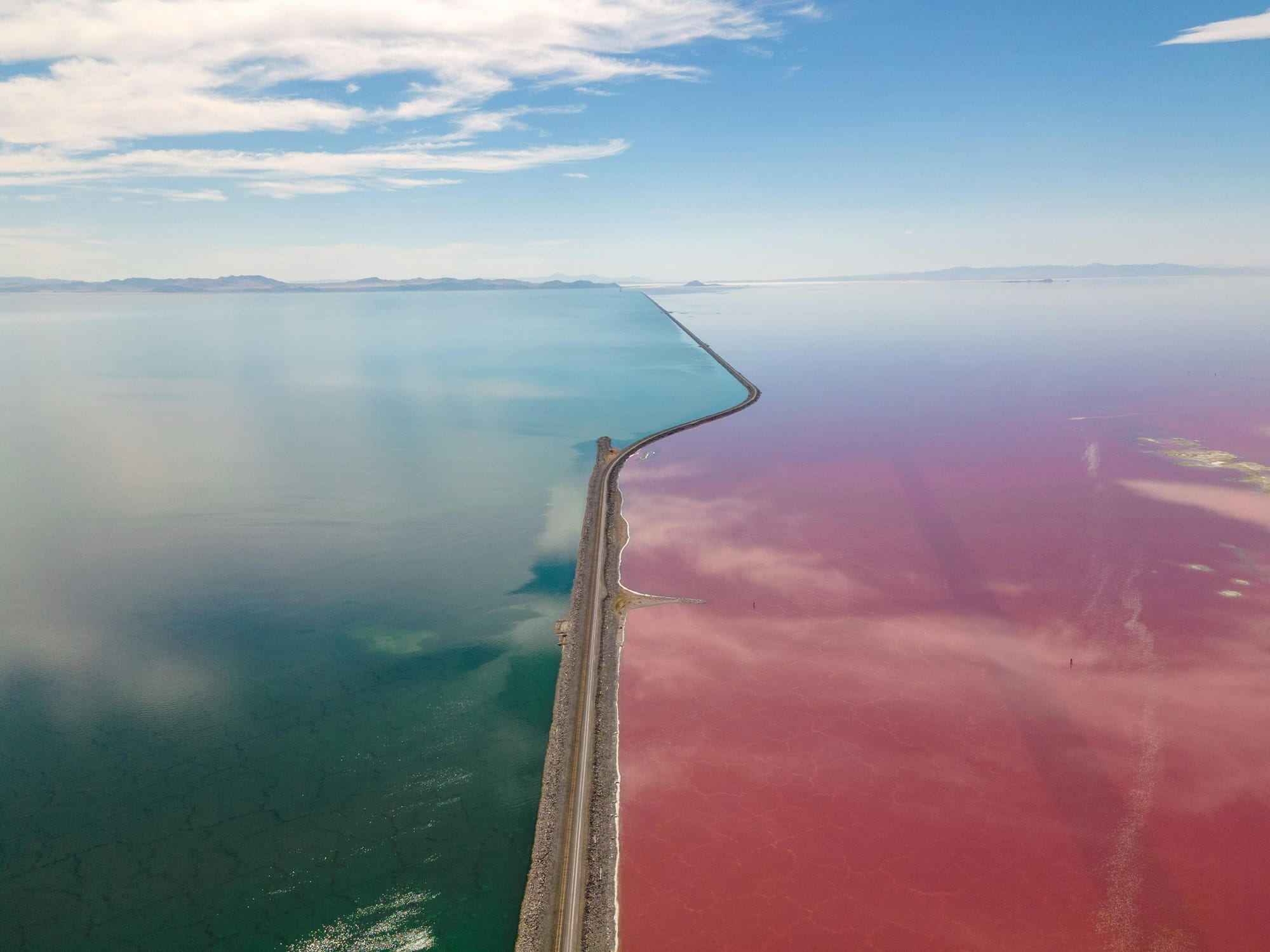
Today, the Great Salt Lake is a totem for the state and a fascinating product of the natural world intersecting with human development. You can see those dynamics by just looking at it from above: The lake is separated into north and south arms, having been bifurcated by the Union Pacific Railroad Causeway in 1959. This division has produced distinct ecological features in each arm — the North is cut off from most freshwater inflows and thus much saltier than its southern counterpart, creating a striking visual difference.
Railway Tracks Dividing Great Salt Lake in Utah, USA | Image: Urvish Oza, Pexels
This post is for paying subscribers only
Sign up now and upgrade your account to read the post and get access to the full library of posts for paying subscribers only.