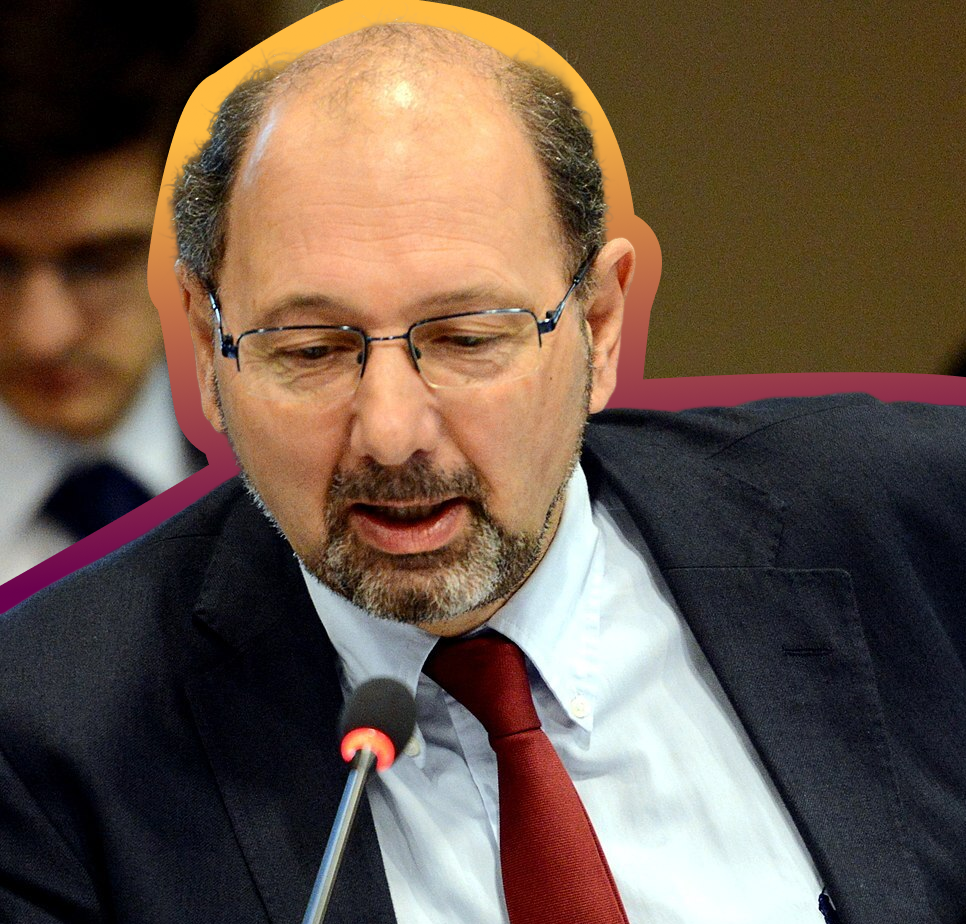
Editor's note: This is a transcription of Tangle Senior Editor Will Kaback's interview with Richard Sakwa, a professor emeritus of Russian and European Politics at the University of Kent at Canterbury and an associate fellow of the Russia and Eurasia Programme at the Royal Institute of International Affairs.
We previewed this interview — and shared a condensed version — in our October 17 Friday edition, which you can read here.
Will Kaback: Richard, thanks so much for joining us.
Richard Sakwa: My pleasure.
Will Kaback: I first encountered your writing fairly recently when I was reading different perspectives on the origins of the war in Ukraine. I was particularly struck by your arguments about the role of Western nations and NATO in catalyzing the conflict, including the all-out invasion in 2022, but also the conflicts that preceded it. For our listeners who aren't familiar with your perspective on the war, can you outline what you see as the roots of this conflict and the degree to which you think the West played a role in forcing Putin’s hand to invade Ukraine?
Richard Sakwa: Thank you. Before going into the way I see things, we could say that there are two dominant visions of what it’s all about, certainly in the West.
The first one is that the war and the conflict in Ukraine is all about Russian imperial expansion, that basically Putin is attempting to reestablish a Soviet Union, or some sort of empire, that Putin is the Hitler of our days, and so on. You then have this endless discussion that you cannot have negotiations because that will be appeasement. So we’re back to 1938 and Munich. The second one, which is tied to it, is that it’s a diversionary war — that basically, Russia has got so many internal complications and difficulties that it lashes out and tries to externalize.
I think that neither of these versions is credible. Internally, the Putin regime is remarkably stabilized. We’ve seen now nearly four years of war, and the regime is still enjoying huge popularity — amazing, incredible even — that it’s well into 80% popular support. Of course, in wartime it’s difficult to get accurate opinion polls, but I think all the evidence suggests that.
So, if those don’t really hold, what are the causes of the war? I would say they’re fourfold, and all four elements make this such a deeply intractable and almost solutionless conflict. The first one is the internal Ukrainian conflict: I’ve argued for many, many years that what we really did need to see within Ukraine is a pluralistic, multi-confessional, multicultural, multilingual settlement, possibly including federalism. It is quite clear that even when the Donbas rebellion began after the Maidan coup — or call it revolution — of February 2014, they weren’t calling for independence initially. It was for what the Russians say — it’s difficult to translate — samostoyatel’nost’, which could be autonomy, it could be something more than that. But certainly the basic view is that it was for autonomy. So internally, it was the failure to reflect Ukraine’s multicultural — well, complex — internal, demographic, cultural, religious framework and give it constitutional form.
The second element is the endless tensions between Russia and Ukraine. Now, this goes back indeed, a thousand years of entwined history, both of antagonism and cooperation. Ukraine was one of the major republics in the Soviet Union. And after 1991, you had this very difficult relationship. Ukrainian nationalism became exceptionally prickly, insecure, and that domestic insecurity was then projected outward in a particularly prickly relationship, an antagonistic one with Russia, seen as the colonial power, and therefore you needed to decolonize, and so on.
The third level is the pan-European one. If you remember, Gorbachev, during his perestroika in the late 1980s, called for a pan-European home, a common European home, and we failed to do that.
That takes us to the fourth level, the U.S.–Russian relationship. I’ve also argued for a long time that after 1945, a political West took shape. You could call it the Euro-Atlantic alliance system, whatever. I think it’s more. It was political; it was cultural; it was all sorts of levels. After the end of the Cold War in 1989–91, the United States insisted on maintaining its hegemony, its dominance, and that precluded allowing Europe to become more autonomous and, indeed, to allow Germany and Russia to come together with France and the other countries. That couldn’t be allowed. We saw that in the Balkans, and we saw that over Ukraine. And so these four levels are like a Rubik’s cube — they all interact with each other — and to solve the war all four faces have to line up, which is going to be jolly difficult.
Will Kaback: So, where do you think things stand now? You’ve just described these four levels. Have they evolved in the nearly four years since Russia’s all-out invasion?
Richard Sakwa: Each one has become far worse, even more difficult to resolve. Internal conflict within Ukraine is far, far more bitter and polarized. The Europeans, as you know, are completely up a creek without a paddle, as it were — completely lost. The “coalition of the willing” is a farce. You remember the picture of the seven clowns (as we call them), or the seven dwarves, around Trump’s table in the Oval Office in the White House. I mean, it really was one of the most shameful episodes in European history — it really was shocking.
And it was just a reflection of our failure — I speak as a European — to establish this “from Lisbon to Vladivostok” idea. So everything has become far worse. Even when Trump tried to break the deadlock by meeting Putin in Alaska on the 13th of September, what happened? Europeans run over him and say, “You can’t make a deal with Russia. We’ve got to continue the war.” What will Europeans continue with? They don’t have much industry left. They don’t have major armies, so they want the United States to commit to this endless war.
So where are we today? I’ve always said, and we’ve always said, as peaceniks, that there is no military solution. Sadly, it looks as if we’re heading towards the only solution being a military one, which, of course, has the huge danger of a third World War. So we are perhaps in a bit of a lull at the moment, but possibly in a more dangerous moment than we’ve ever been before.
Will Kaback: I want to tease out the Trump aspect of this a little bit more because he’s about eight months into his term and has taken, in some ways, a markedly different approach to the conflict than President Biden did. In other ways, there have been similarities in how his administration has handled the war and worked with European nations. But what do you see as the key differences between the Biden approach and the Trump approach? And are you more hopeful for a peaceful, non-military resolution with Trump now? Or do concerns remain?
Richard Sakwa: At the beginning, we did have a certain feeling that Trump had always said, all the way back to 2016, if not earlier, that it makes sense to get on with Russia — his famous Mayflower speech in April 2016. If he couldn’t do it in his first term because of Russiagate and he had to prove that he wasn’t in Putin’s pocket — therefore he had to act extra tough — but we’ve seen in these last eight months a litany of failures.
We now understand that he simply does not understand the deeper, what Putin would call the “root causes.” And so therefore he’s a bit like a weathervane — the wind blows from Brussels, he goes that way from Kyiv, he goes that way from Moscow — which is very different from Biden. Biden had absolutely no contact with Moscow after the war began. And even the contacts before that were rather, well, I’d say confused and really not diplomatic, they just consisted of a series of threats. So it was very different. We expected it to be different.
I don’t want to go too long, but I’ll just say that the Trump phenomenon is a complex one. And one reason why we thought that there would be a hope for a new type of approach was the fact that the Trump phenomenon, in my view, consists of at least four defections.
The first defection is potentially from this political West, from this Euro-Atlantic alliance. We know he's got nothing but contempt for the European Union. He even said earlier that NATO was obsolete. Well, he hasn’t followed through on that at all. We thought that would open up a potential for some sort of pan-European, a new angle of approach.
The second defection is from the United Nations-based international system — the idea that, “This is the international law,” and all of that, which Trump is very critical of. He’s not the first, of course, to be highly critical of the United Nations. He’s left the UN Human Rights Commission World Health Organization for the second time, and he is basically, as you know, contemptuous of international law and U.S. international treaties.
The third defection is from the U.S. Constitution domestically.
And the fourth defection is the Steve Bannon dismantling or deconstruction of the administrative state. Of course, Elon Musk has gone, but I think the deconstruction by DOGE is continuing. You could say there have been plenty of other defections from the international political economy as conducted largely since the Second World War.
So in that package, there were some positives. Clearly NATO is a dysfunctional organization internally and catastrophic for Europe and global politics internationally. Absolutely catastrophic. It keeps boasting with its 32 members, the most successful military organization in history. It basically exists to sustain its own existence, and to do that it has to foster and generate conflict. So you could say it’s the most disastrous military alliance in history. It should have gone after 1989 and the end of the first Cold War.
Will Kaback: That segues into another question I wanted to cover, which is this notion of Putin’s imperial ambitions, his ambitions beyond Ukraine, which I think NATO members or NATO supporters would say is a reason that the alliance is necessary. Do you believe that Putin has imperial ambitions beyond Ukraine?
Richard Sakwa: Absolutely not.